TABLE OF CONTENTS

 1.
Village Overview
1.
Village Overview
- Interpretation
 ACTIVITIES
1.
Sensitization & Ground Truthing
 2.
Formation of VNRMC
2.
Formation of VNRMC
3.
Opening of Bank Account 4. Participatory Rural
5.
PRA Exercise
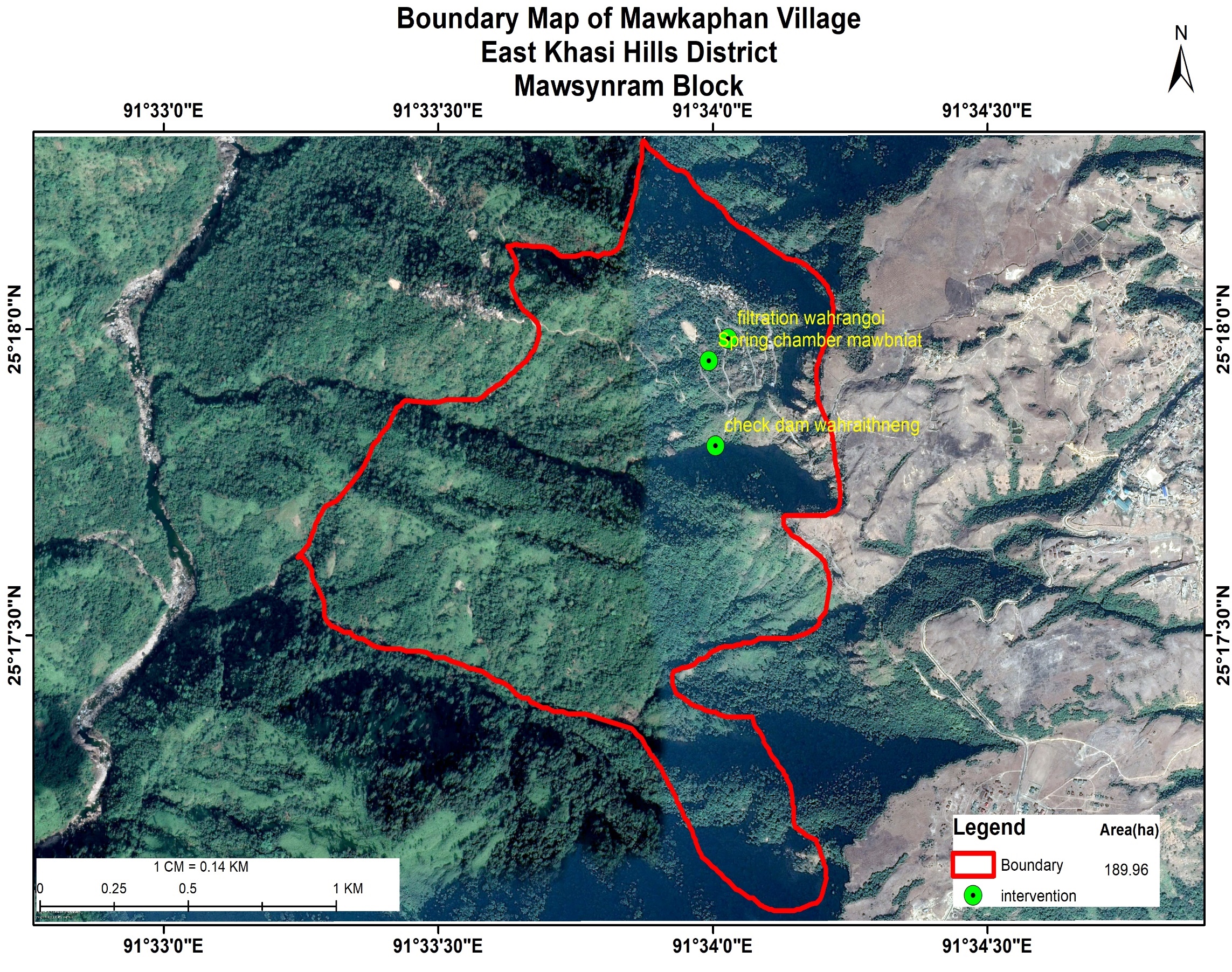 Village Boundary
Map
Village Boundary
Map
Community Led Landscape Management Project
The Government of Meghalaya with financial aid from the World Bank is implementing the Meghalaya Community Led Landscape Management Project (MCCLMP). The project will cover the entire state of Meghalaya and implementation of community led plans will be rolled out in a phase manner throughout the state. The Meghalaya Basin Management Agency (MBMA) will facilitate community-led planning by providing support, technical inputs and funding.
The project is intended to strengthen community-led natural resources management in selected landscapes within the 7 districts of the state. This would be achieved through a variety of planning, capacity building, and on-the-ground interventions to promote the conservation, sustainable use of natural resources, social inclusion and community mobilisation; building traditional knowledge and learning, mapping of natural resources management; strengthening the community institutions and creating linkage with financial institutions and community organisations.
The project interventions will include preparation of community led natural resource management plans. The CLLMP has the following three components:
Strengthening Knowledge and Capacity of Communities for Natural Resources Management
Community-Led Landscape Planning and Implementation
Project Management and Governance
The project objective is “to manage and conserve the natural resources, especially forests, soil and water sources, in a manner that supports the financial and physical well-being of communities in the State”
Village Overview
Mawkaphan village falls under Mawsynram C&RD Block of East Khasi Hills in the state of Meghalaya. The village is situated 6 km away from sub-district headquarter Mawsynram and 62 km away from district headquarter Shillong. Most of the land in the village is mainly owned by private individuals.
Mawkaphan has a total population of 603 peoples of which 298 are males and 305 are females. There are about 112 houses in Mawkaphan village. Mawsynram is nearest town to Mawkaphan.
First Contact
The first contact with Mawkaphan village was established with the headman of the village Bah Gibonsing Kynter on the 10th June 2019. Ground truthing was also done on the same day. Some of the findings after discussion with the headman and ground truthing were:
The agricultural produce are insufficient for everyday use
The main issues arising in the village is related to water
All of the SHG present in the village are run by the women of the village
Majority of the people in the village are engaged in agriculture, handicraft and trading
Findings
Traditional and Indigenous Practitioners in the Village people
The village still has no traditional healers or traditional indigenous practices.
Various Government Schemes availed in the village
Mahatma Gandhi National Rural Employment Guarantee Act
Indigenous Food available
Pu-sla and Pu-Khlein (Market Days)
Women Participation in the Village
Does not allow women to attend the village Dorbar
Only allows in the times for meeting for MGNREGA or cleaning drives meeting
Not allowed in the decision making process
Challenges faced by the people in the village
The village faces a number of issues relating to water supply
Numbers of CBO/ SHGs/ CLUBS in the Village
Kpersara SHG
Iaikyrsoi SHG
Iaipyrshang SHG
Activities Carried out in the Village
Cleaning Drive
Banking
Youth Participation
Participation of youth is quite good in the village
Number of Fair price shop
1 FPS
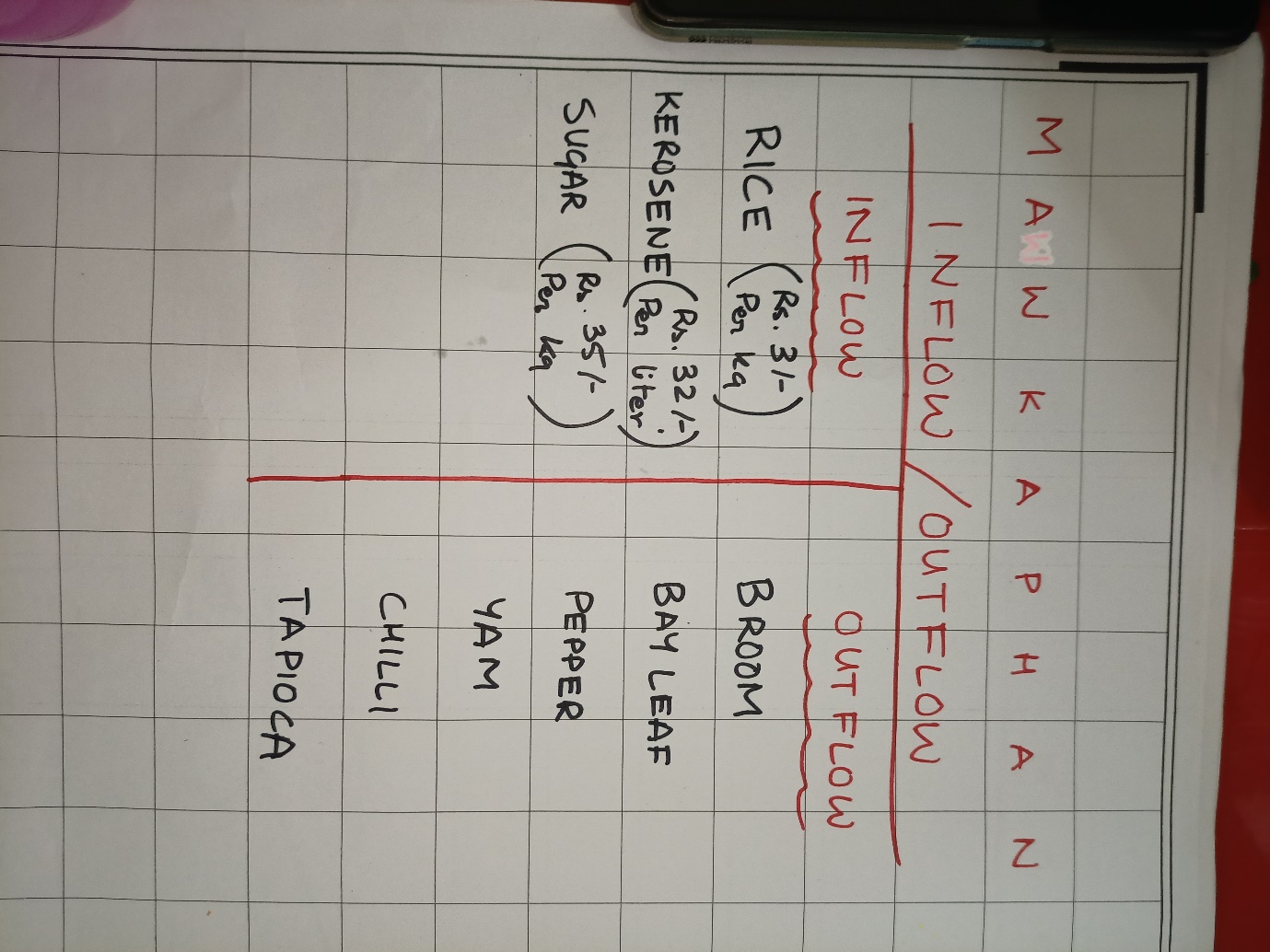
Prices of Essential Commodities
Rice ₹3 /- per kg
Kerosene ₹32/- per litre
Sugar ₹35/- per kg
Amount of Kg/ Liter received for each Commodity
5 kg per person from PHH
35 kg per household
Type of Ration Cards
Priority Household (PHH) Card
Antyodaya Anna Yojana (AAY) Card
Outflow of Resources
Broom
Bay leaf
Pepper
Yam
Chilli
Tapioca
Farming methods practiced in the village
Traditional Farming Practices
Types of Fertilizers
Organic manure
Marketability of Crops
Once a week
Distance to the Market
20 minutes at the price of ₹20 /- for transportation
Mode of transport
Local transport (local taxi, buses and sumo)
Daily Wage
₹300 for male
₹180 for female
Seasonal crops cultivated
Yam
Chilli
Sweet Potato
Chilli
Number of Local Market & Frequency
Weekly
Market Authority
Syiemship
Taxation in the Local Market
Taxes for selling Bay leaf and broom have to be paid to the Syiem (King)
LAND USE PATTERN
Land Ownership
Private
Land usage
Farming
Natural Features of the Land
Mountains and Hills
Tress and other vegetation
Ponds, streams and rivers
Resources present in the Land
Natural resources (forest, streams and rivers)
Natural and Man-made Disasters
Landslides
Flora and Fauna
Indigenous birds (Tiew Mationg).
Squirrel
Major trees in the Village
Dieng sohphan
Dieng sla tyrpad
Dieng Rai tylleng
Trees that helps in Spring Discharge
Dieng sohphan
Dieng sla tyrpad
Dieng Rai
Dieng Tylleng
Sharing Of catchment Areas with other villages
No
WATER SOURCES
Main Source of Water
Public tab
Well
Main source of Drinking Water
Public tab/ PHE
Community Well
Distance of water sources (in meters)
3 metres
Time taken to fetch water (in minutes)
1-2 minutes
Frequency of water supply
24 hours
Is the frequency sufficient?
Yes
Quality of the water
Excellent
Colour of the water
Clear
Water Scarcity months
December to April
Is water source well maintained?
Yes
Satisfaction of drinking water supply
Satisfied
ENVIRONMENT
Availability of traditional environmental protection beliefs
No
Waste management system
No
Is Deforestation practice in the village
Yes, with the rise of population in the village forest land have been cut down
Is Afforestation practice in the village
Yes, once in a while
Control measures for soil erosion
No
Interpretation
Traditional and Indigenous Practitioners in the Village people
The village has no traditional healers or any traditional indigenous practices in the village. With the change in time and techniques the people have transition to modern and more relevant practises which have resulted in the disappearance of these traditional indigenous practices.
Government Schemes availed in the village
The only major schemes in the village is the Mahatma Gandhi National Rural Employment Guarantee Act scheme is the most active in the village in terms of regularity and services. The scheme is used by the villagers to improve their overall well-being in the village. The study interprets that the population of the village are highly dependent on the scheme and services provided by the Government.
Indigenous Food available
The village has some sources of indigenous food that’s have been practice by their ancestors and has continued till today in the present generation. Some of these food are Pu-sla and Pu-Khlien.
Women Participation in the Village
Through the baseline study, the village exclude women from attending the meetings of the Dorbar and they are also not involve in the decision making process regarding the welfare of the village. The only time where women are involve and included win the Dorbar is when there is a meeting regarding the MGNREGA scheme or cleaning drives meeting.
Problems and Challenges faced by the people in the village
There are not much problems in the village but the FGD identified that water is the main issue that the people in the village encounter. Although the quality and supply of water is quite good the problem arises during the winter seasons where water supply begins to be scarce.
Numbers of CBO/ SHGs/ CLUBS in the Village
The village is constitutes of 3 Self Help Groups which are Kpersara SHG, Iaikyrsoi SHG and Iaipyrshang. All of them are functioning actively and act as contributors to the well-being of the village. The existence of diverse groups shows that the village has a strong participation from its members.
Land use Pattern
The landholdings shows that land is largely owned Private individuals. In terms of natural features of the village consists of mountains, hills, ponds, streams and rivers.
The types of trees are found in large number are primarily 4 types Dieng Sohphan, Dieng Sla Tyrpad, Dieng Rai and Dieng Tylleng.
Water Source
From the findings, it can be interpreted that the villages receive an abundant and frequent supply of water. They expressed their satisfaction with the frequency of water supply which is 24 hours and the quality since the water is clear in colour, but there is a water shortage form the month of December to April.
Environment
The villages understand the importance of conserving the forest and its resources. In terms of protecting the environment they shared that the trees are planted once in a while but there are also wild ones that grows at their own pace. The village practice both deforestation and afforestation, but deforestation only happens due to the increase in population in the village. They do not have any traditional methods or practices in protecting the environment or neither do they practice any modern method of waste management.
Activities
The first sensitisation programme was conducted on 10th June 2019, in the Community Hall of the village. The programme was presided over by the headman of the village. Approximately 12-15 residents attended the sensitisation programme. The ADPM of East Khasi Hills, Mr. Pynshngain Rymmai gave an introduction to the Community Led Landscape Management Project (CLLMP) and its various nuances that the community and the CLLMP team should carry out throughout the course of the project. The first priority was establishing of the Village Natural Resource Management Committee (VNRMC) and thereafter formulation of the Community Natural Resource Management Plan (CNRMP) was to be prepared.
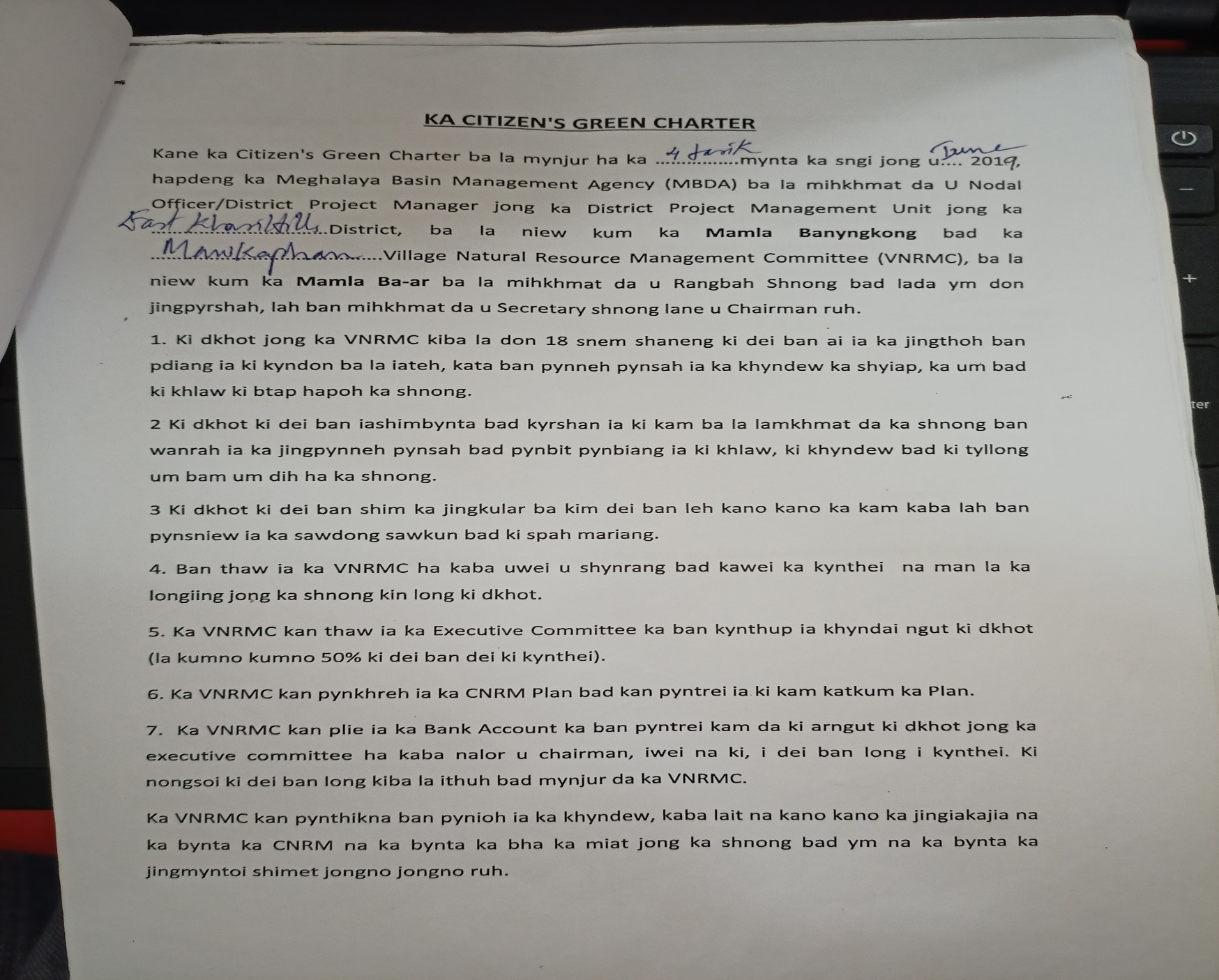
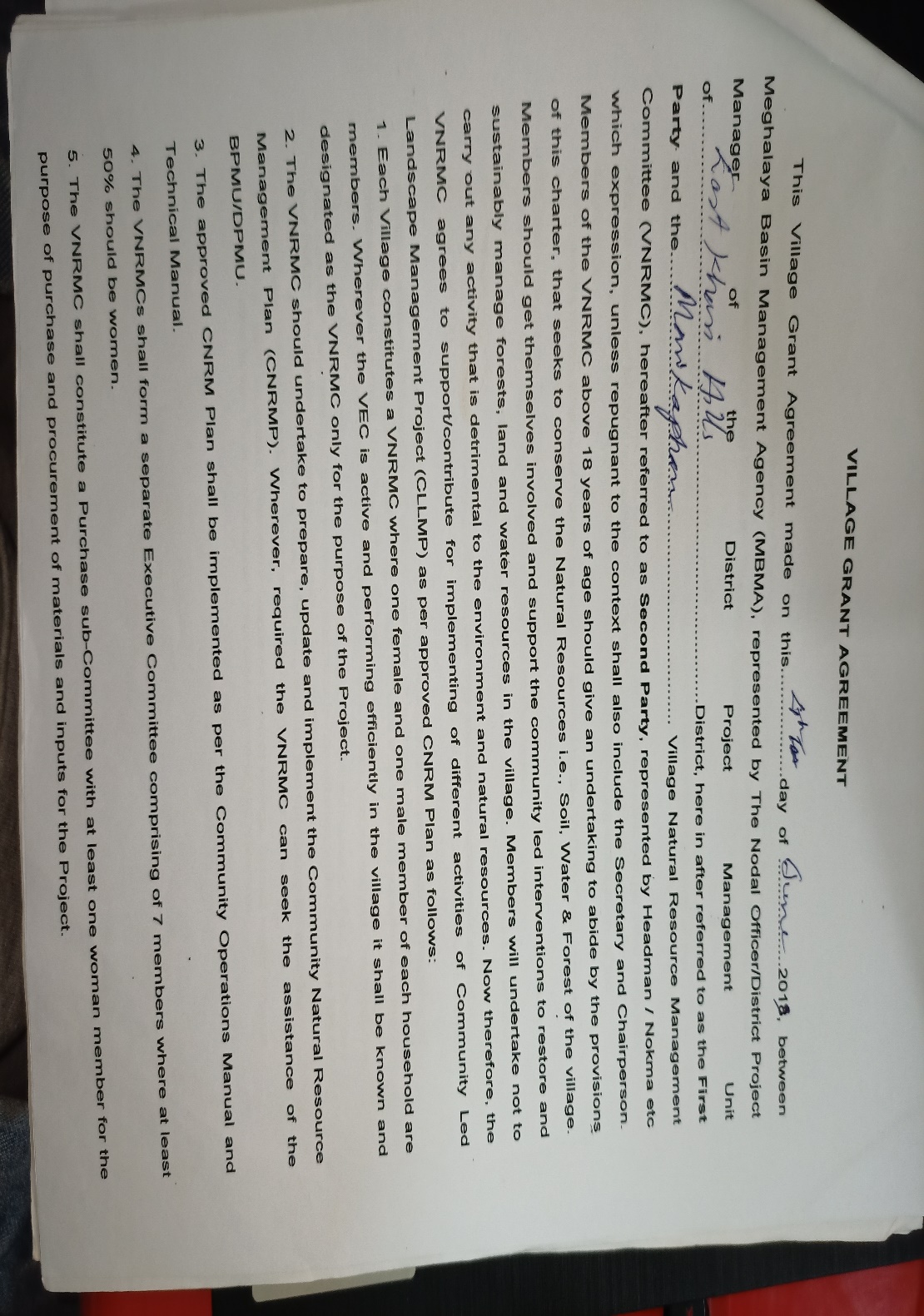
The executive committee of the Dorbar Shnong of Mawkaphan, after a meeting formed the members of VNRMC on 18th May 2019. The signing of the VGA and Citizen’s Green Charter on the 4th June 2019 and signing of EOI was done on 26th June 2019.
| 2.2 Village Natural Resource Management Committee (9 member committee constituted from Village Council and VEC, SHG group, Women’s group, youth, 4 members should be women) | |||||||||
|---|---|---|---|---|---|---|---|---|---|
| Sl No | Name in Full | Gender M/F | Age (in Yrs) | Education | Designation | Occupation | Community | Religion & Denomination | Contact No and email address |
| 1 | Pyrkhatlang Dewsaw | M | 27 | BA | Chairman | Business | Khasi | Christian | 9366961315 |
| 2 | Skhembhalang Disiar | F | 30 | BA | Secretary | Teacher | Khasi | Christian | |
| 3 | Bredingstar Kynter | M | 50 | xii | Treasurer | Teacher | Khasi | Christian | |
| 4 | Gibon Kynter | M | 35 | ix | member | labourer | Khasi | non-Christian | |
| 5 | Sanphrang Marbaniang | M | 50 | x | member | Government employee | Khasi | Christian | |
| 6 | Glasshon Dewsaw | M | 79 | viii | member | retired government employee | Khasi | Christian | |
| 7 | Toman Kynter | M | 45 | viii | member | farmer | Khasi | ||
| 8 | Baiahun Kynter | F | 29 | BA | member | Teacher | Khasi | Christian | |
| 9 | Juncy Disiar | F | 50 | VIII | labouer | Khasi | non-Christian | ||
| 10 | Enjoymen Kynter | F | 48 | VIII | member | labouer | Khasi | Christian | |
The opening of bank account was initiated after the village signed the EOI (Expression of Interest), VGA (Village Grant Agreement) and the Citizen’s Green Charter. Mawkaphan opened their bank account on the 26th June, 2019.
Book Keeping Training
 Miss Balarihun Kharpuri,
Programme Associate (Finance and Procurement) of East Khasi Hills,
CLLMP, conducted the Simple Book Keeping Training on the
10th of June 2019, at Mawkaphan village.
Miss Balarihun Kharpuri,
Programme Associate (Finance and Procurement) of East Khasi Hills,
CLLMP, conducted the Simple Book Keeping Training on the
10th of June 2019, at Mawkaphan village.
Training on the development of the Community Natural Resource Management Plan (CNRMP)
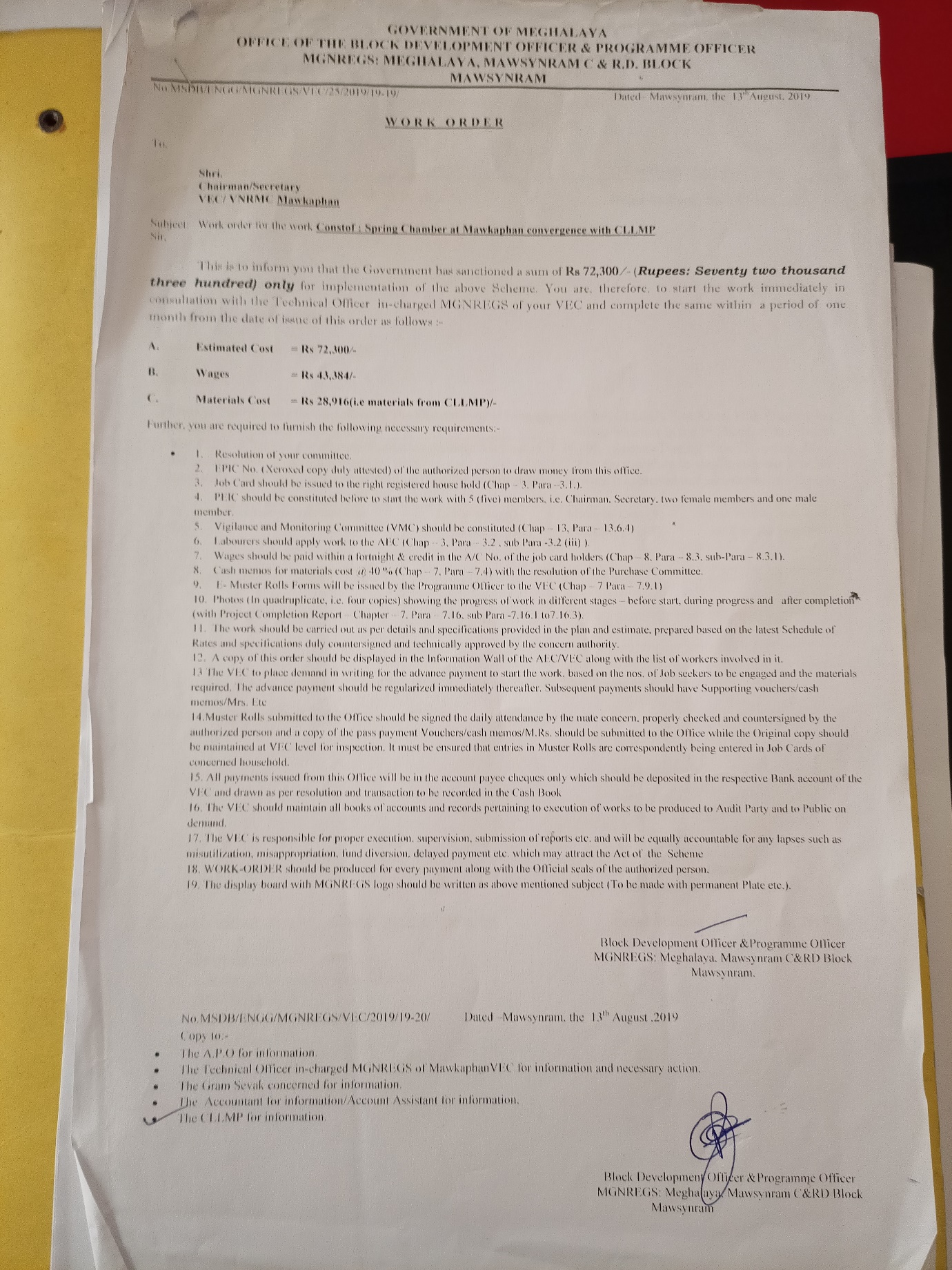
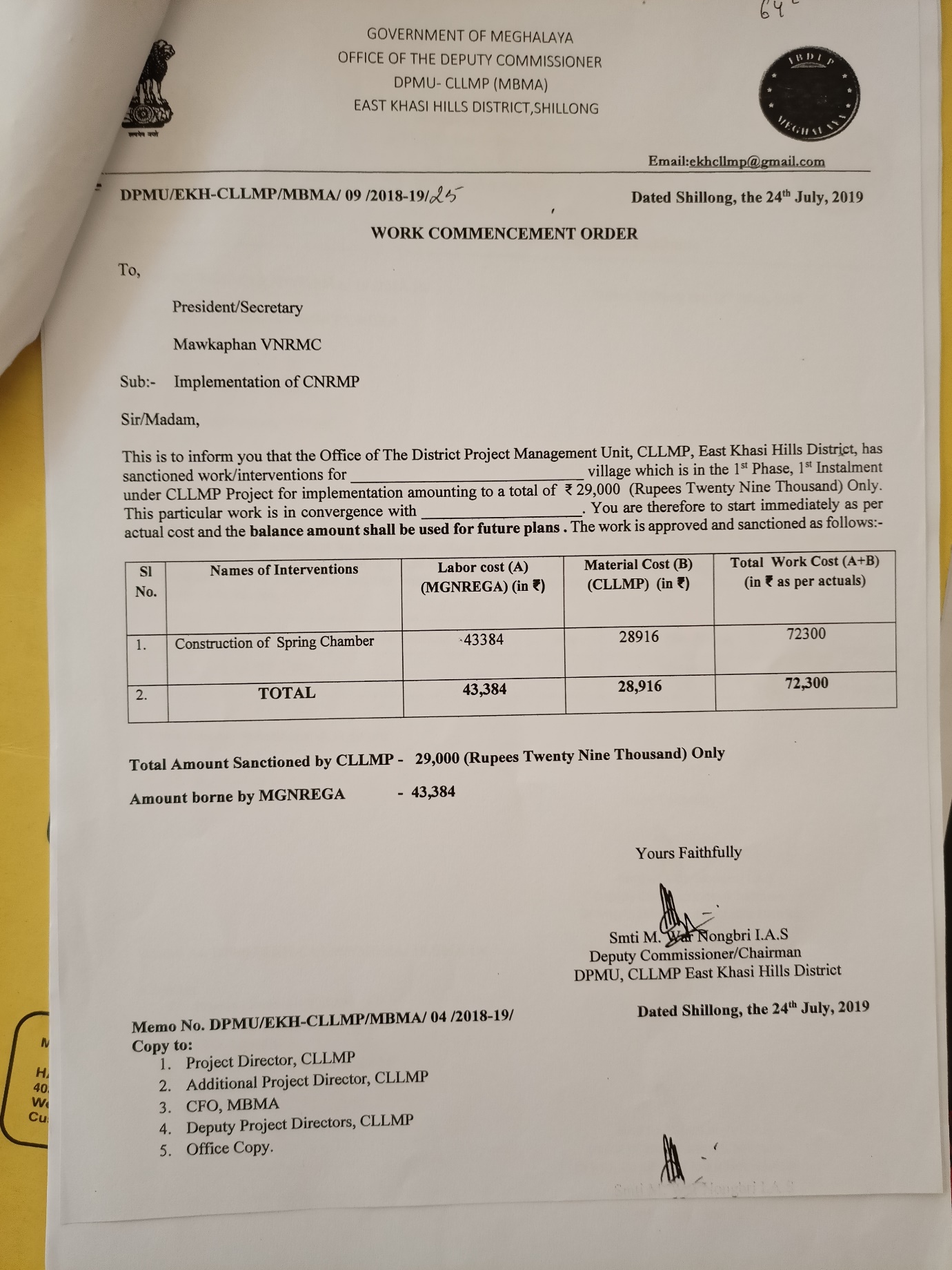
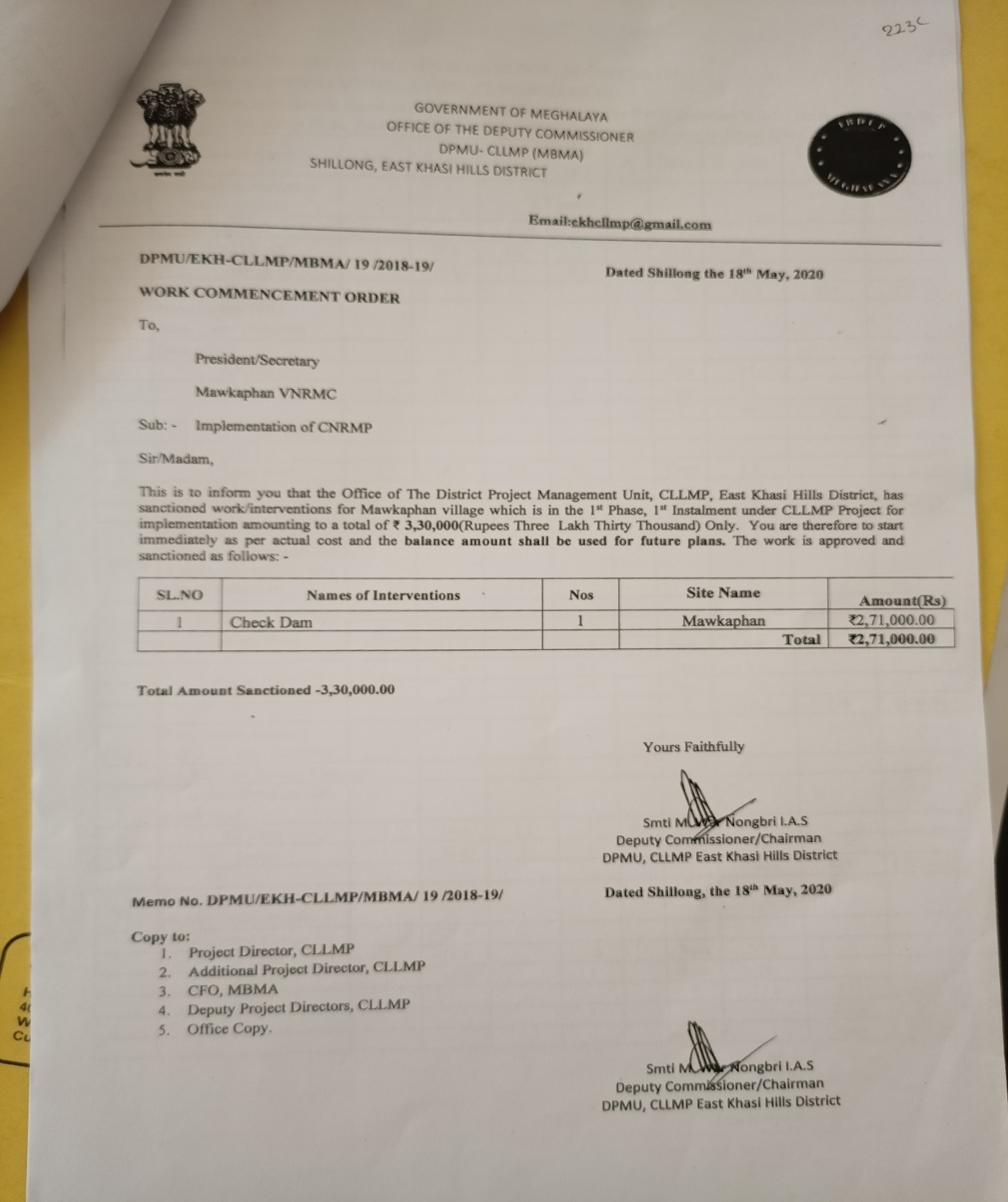
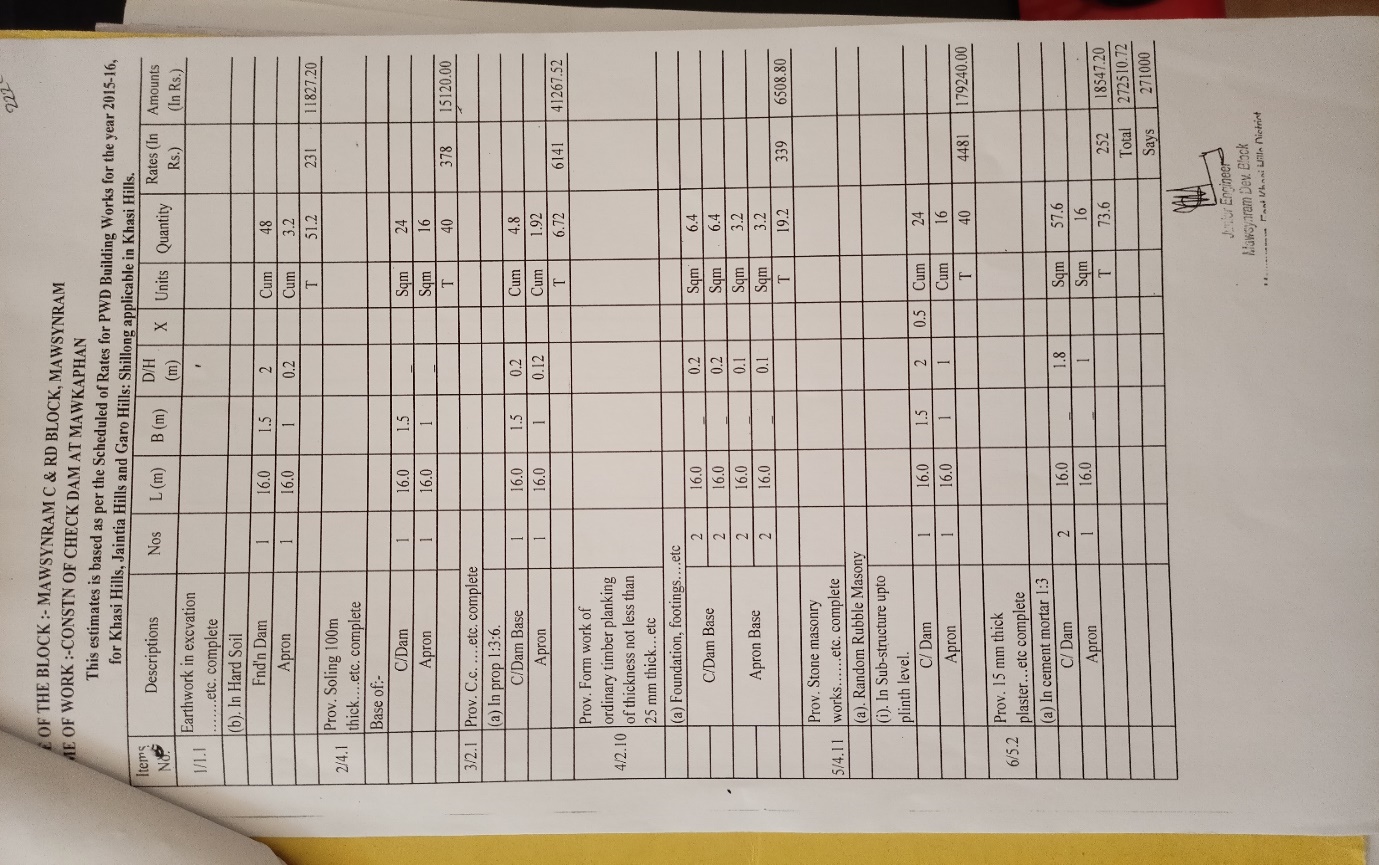
Development of the CNRMP was initiated in Mawkaphan village on the 10th of June, 2019. As of this juncture; they laid down two interventions pertaining to water development in the village. (check dam and spring chamber)
A comprehensive one-day training and existing CNRMP review for the VNRMC executive members under all the villages under East Khasi Hills was organised on the of December, 2019 by the members of the DPMU. A copy of the environmental templates along with the boundary maps were also circulated to the members and explanation to the templates were made accordingly.
Project Implementation
Community Natural Resource Management Plan Template
VILLAGE SUMMARY
| District : East Khasi Hills Block : Mawsynram Village: Mawkaphan | |
|---|---|
| Postal Address: Sentein PIN: 793113 | |
VILLAGE GIS MAP(Baseline Land use land cover map of village to be prepared using information from GIS Atlas and Google Earth as a first step before community mobilisation in the village)
| Sl. No. | Parameters (sl.no.1&2 to be filled by GIS Expert) | Village Information | |||||||||||
|---|---|---|---|---|---|---|---|---|---|---|---|---|---|
| 1 | GPS Coordinates: | ||||||||||||
| i | Latitude | 25.300838 | |||||||||||
| ii | Longitude | 91.567239 | |||||||||||
| iii | Elevation Reading (MSL) | 1103 | |||||||||||
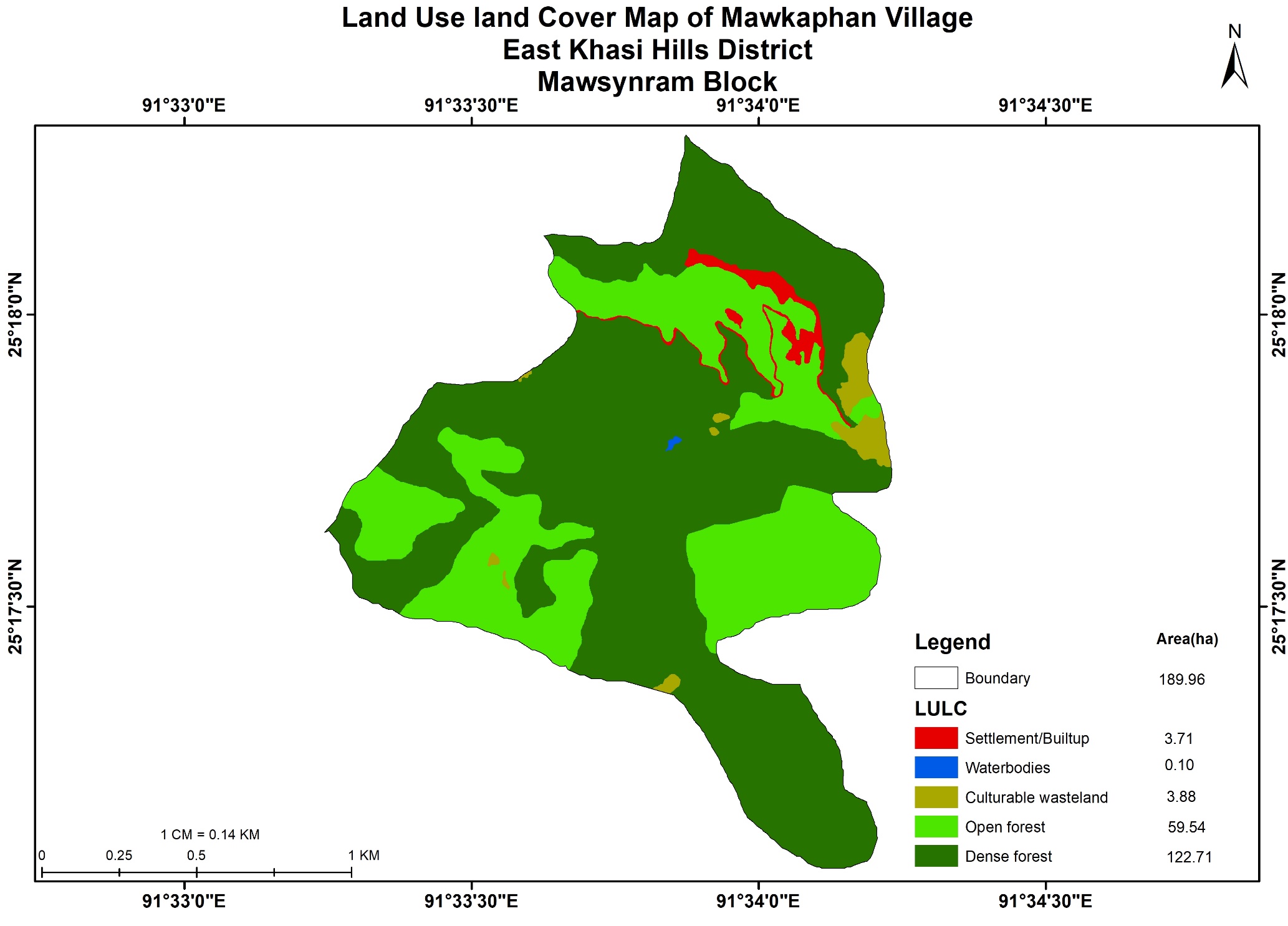
| 2 | Village Geographical Area (Ha) | 189.96 ha | |||||||||||
| i | Total Forest Area (including community, Clan, Pvt Forest) | 182.25 ha | |||||||||||
| ii | Total Area of Water Bodies | 0.10 ha | |||||||||||
| iii | Total Area under Agri-Horticulture | N/A | |||||||||||
| iv | Total Degraded land area (Ha) | 3.88 h | |||||||||||
| 3 | Average Annual Rainfall (data to be collected from secondary data by DPMU at district/block level and need not be village level) | ……………mm | |||||||||||
| 4 | Soil Type(data to be collected from secondary data by DPMU) | ||||||||||||
|
|||||||||||||
| Sl. No. | Parameters | Village Information | |||||||||||
| 1 | Traditional Land tenure system (Hima /Raid/ /Doloiship/sirdarship/Nokmaakingetc) | Maharam Syiemship | |||||||||||
| 2 | Distance from Block HQ (Km) | 6 | |||||||||||
| 3 | Distance from District HQ(Km) | 62 | |||||||||||
| 4 | Community inhabiting the village (Khasi, jaintia, Garo & Others) | Khasi | |||||||||||
| 5 | No of HHs in the village | 112 | |||||||||||
| 6 | Total population | 603 | |||||||||||
| 7 | Demographic | M | F | Total | |||||||||
| i | 0-4 | 22 | 40 | 62 | |||||||||
| ii | 5-14 | 91 | 72 | 163 | |||||||||
| iii | 15-30 | 80 | 70 | 150 | |||||||||
| iv | 30-60 | 75 | 85 | 160 | |||||||||
| v | Above 60 | 30 | 38 | 68 | |||||||||
| Total | 298 | 305 | 603 | ||||||||||
| 8 | Major occupations of people in the village (in order of importance). (Collect only one major occupation per HH. The Number of all occupation should be equal to total no.of HH in the village.) | ||||||||||||
| Occupations | HHs | ||||||||||||
| i | Labourer/farmer | 89 | |||||||||||
| ii | Business | 7 | |||||||||||
| iii | Teacher | 1 | |||||||||||
| iv | Government Employee | 15 | |||||||||||
| v | |||||||||||||
| vi | |||||||||||||
| 9 | Public Transport Facilities to & from village Yes/No:…if yes (specify) |
|
|||||||||||
|
|||||||||||||
| 10 | Energy fuel use by HHs | No of HH | Qty (Kg/HH) | Total | |||||||||
| i | Charcoal | 0 | 0 | 0 | |||||||||
| ii | Wood | 111 | 1825 | 2,02,575 | |||||||||
| iii | LPG | 1 | 168 | 168 | |||||||||
| iv | Kerosene | ||||||||||||
| v | Electricity | ||||||||||||
| 11 | Does the village have sites of Tourist interest | No | |||||||||||
| If Yes mention the site & No of Tourist | No of Tourist per Year: | ||||||||||||
| i | NA | ||||||||||||
| ii | NA | ||||||||||||
| iii | NA | ||||||||||||
| 12 | Number of Village Institution with their status | ||||||||||||
| Village Council/ VEC/Traditional Institutions | Yes | ||||||||||||
| Water and Sanitation Committee | No | ||||||||||||
| Self Help Group for Livelihood Activities |
|
||||||||||||
| Other if any | |||||||||||||
| 13 | Availability of Govt. Water Supply (Y/N) | Yes | |||||||||||
2.1 Traditional Village Institutional Functionaries (Village Dorbar/Nokma/Doloi Council) |
||||||||||||||||||||
|---|---|---|---|---|---|---|---|---|---|---|---|---|---|---|---|---|---|---|---|---|
| Sl No | Name in Full | Gender M/F | Age (in Yrs) | Education | Designation | Occupation | Community | Religion & Denomination | Contact No and email address | |||||||||||
| 1 | Gibonsing Kynter | M | 35 | IX | Headman | Farmer | Khasi | Christian | 9366744901 | |||||||||||
| 2 | Sanphrang Marbaniang | M | 50 | X | Secretary | Govt. Employee | Khasi | Christian | ||||||||||||
| 3 | Bredong Kynter | M | 50 | XII | Treasurer | Teacher | Khasi | Christian | ||||||||||||
| 2.2 | Village Natural Resource Management Committee (9member committee constituted from Village Council and VEC), SHG group, Women’s group, youth;4 members should be women) | |||||||||||||||||||
| Sl No | Name in Full | Gender M/F | Age (in Yrs) | Education | Designation | Occupation | Community | Religion & Denomination | Contact No and email address | |||||||||||
| 1 | Pyrkhatlang Dewsaw | M | 27 | BA | Chairman | Bussiness | Khasi | Christian | 9366961315 | |||||||||||
| 2 | Skhembhalang Disiar | F | 30 | BA | Secretary | Teacher | Khasi | Christian | ||||||||||||
| 3 | Bredingstar Kynter | M | 50 | xii | Treasurer | Teacher | Khasi | Christian | ||||||||||||
| 4 | Gibon Kynter | M | 35 | ix | member | labouer | Khasi | non-Christian | ||||||||||||
| 5 | Sanphrang Marbaniang | M | 50 | x | member | government employee | Khasi | Christian | ||||||||||||
| 6 | Glasshon Dewsaw | M | 79 | viii | member | retired government employee | Khasi | Christian | ||||||||||||
| 7 | Toman Kynter | M | 45 | viii | member | farmer | Khasi | |||||||||||||
| 8 | Baiahun Kynter | F | 29 | BA | member | Teacher | Khasi | Christian | ||||||||||||
| 9 | Juncy Disiar | F | 50 | VIII | labouer | Khasi | non-Christian | |||||||||||||
| 10 | Enjoymen Kynter | F | 48 | VIII | member | labouer | Khasi | Christian | ||||||||||||
2.3 Green Facilitators
| Sl No | Name in Full | Gender M/F | Age (Yrs) | Education | Area of specialisation/ focus (forests, water, soil, accounts, environmental and social safeguards, knowledge management, GIS) | Trained under CLLMP (Yes/ No?) if Yes, date training was received | Contact No and email address |
|---|---|---|---|---|---|---|---|
| 1 | Sarjon Disiar | M | 27 | xii (LABOURER) | Forest | No | |
| 2 | Iadalin Disiar | F | 24 | xii (Student) | Water | No | |
| 3 | Bashisha Nongsiej | F | 25 | xii (LABOURER) | Soil | No |
RESOURCE MAPPING
| 1 | The exercise should be done in a public place, that all members of the community, can access and participate in; |
|---|---|
| 2 | Facilitators should carry GIS map of village/ Google Earth Map |
| 3 | Introduction on Resource Map to the community; entire community to be present |
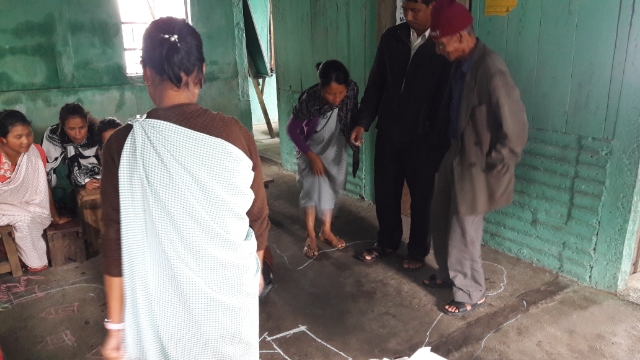
| 4 | Facilitate the community to draw the Village Resource Map of the village on the floor/open ground/Chart Paper using participatory tools and locally available materials |
| 5 | Facilitate community to draw village Boundary-basic landmarks such as roads streams, rivers, forests, agricultural land etc |
| 6 | Map out details of land use such as Community forest, clan forest, Pvt individual forest, Jhum area, important cash crop areas, Agriculture areas, Agro forestry, degraded land area, sand/stone quarries, coal mining areas, steep slope areas, low land areas, wasteland & Plant species in each forest type etc. |
| 7 | Map out details of water bodies such as springs &springshed, water catchment areas, ponds, lakes, water reservoirs, sites for fishing etc & Temporary features (Seasonal ponds/Lakes) etc |
| 8 | Briefing and validation of the Resource Map with the community. Copy the Resource Map on the paper for official record. Use Standard legends for uniformity and convenience. |
| 9 | Ensure that participants engaged in drawing Resource maps including VNRM committee sign and date at the back of the Resource Map and it is endorsed by the head of the village council |
| 10 | It is recommended that the group prepare two copies of Resource Maps, so that one copy may be given to the community for their future reference. Take a photo |
(This is the tool to begin interaction with the people in the village. This exercise will provide an opportunity to bring people together to understand the natural resources of the village towards plan preparation. The facilitators must have the secondary information in advance to be able to facilitate effectively; The information collected through this process should be filled into the template provided for Land Use Pattern.)
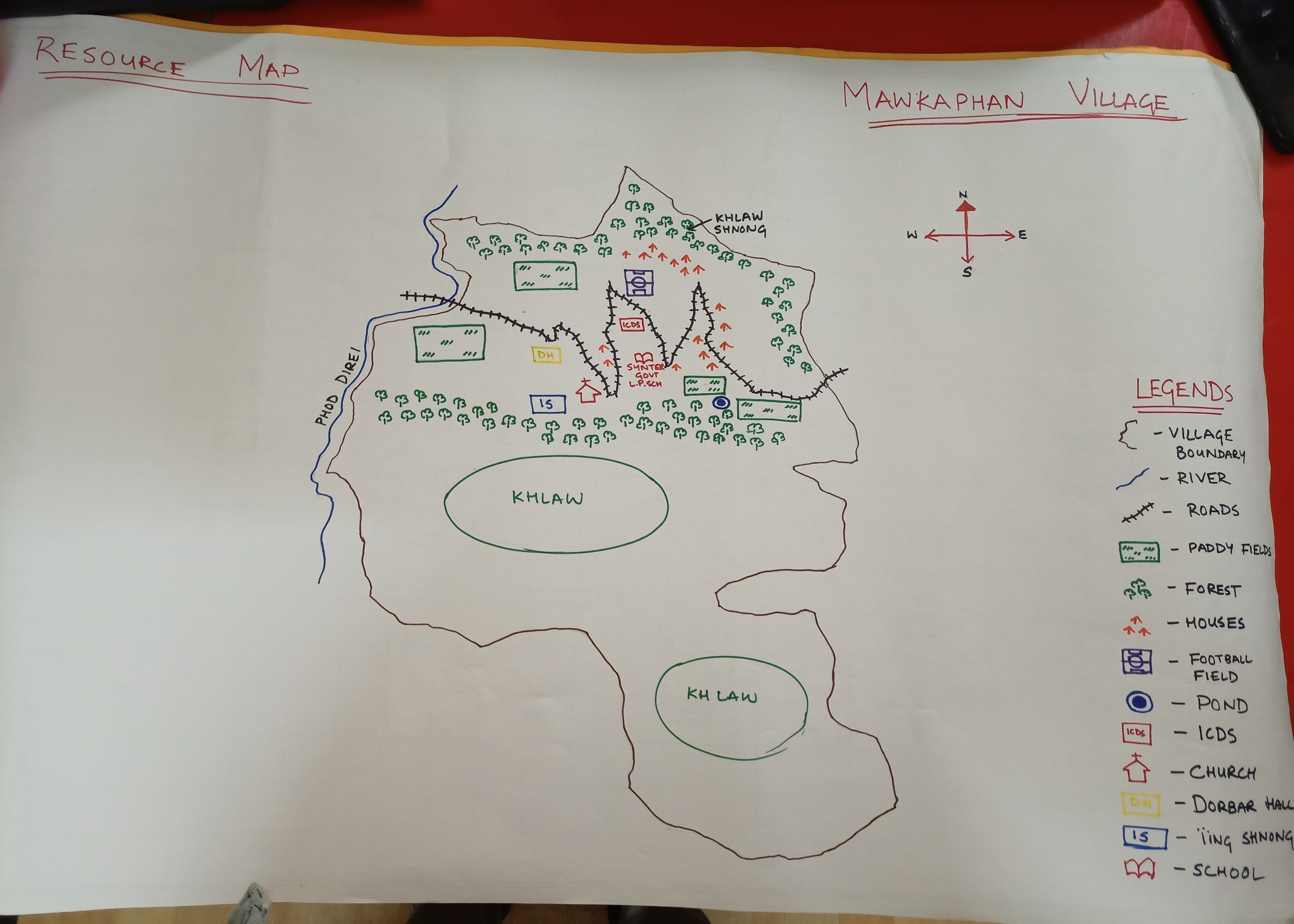
LAND USE PATTERN
| Sl No | Land use Category | Land Ownership (Community/Clan /Pvt individual etc) |
Name of the Site |
Quality of forest(Dense, Moderate, open) refer to GIS Map | Land Area /stretch as in the vilage (Ha/Km) |
Present Uses/Benefits HHs=1; Timber =2; NTFP =3; Fuelwood = 4; Medicine & Aromatic plants=5, Others=6 |
Land Area available for intervention (Ha) | Grazing (Y/N) |
Remarks |
|---|---|---|---|---|---|---|---|---|---|
| 4.1 | Forest (Specify type)(total area of all forest should match with forest area of the village measured under GIS) | ||||||||
| Community Forest (Lawshnong/SongniBirungbolgrik) | Community | Mawkynjangbah | Moderate | 3 | No | ||||
| Private (Rikynti/) | Community (Raid) | Mawiongrit | Moderate | 2, 4 | Yes | ||||
| Clan Forest (Lawkur/Maharini/ Raid | NA | NA | NA | NA | NA | NA | Yes | There’s no clan forest | |
| Protected Forests/ Green Blocks (including Law Adong and Law shnong, forests protected for aesthetic reasons) | NA | NA | NA | NA | NA | NA | NA | There’s no protected forest | |
| Catchment Areas (water supply) (Area to be filled by GIS) | NA | NA | NA | NA | NA | NA | There’s no catchment area |
| SL. No. | Land use Category | Land Ownership (Community/Pvt individual etc) |
Name of the Site |
Land Area available for intervention (Ha) | Source of Seeds Community Nursery=1 Purchase=2 Others=3 |
Use of Organic Fertiliser/Bio-Pesticide/Bio-Insecticides etc. (Y/N) |
Remarks |
|---|---|---|---|---|---|---|---|
| 4.2 | Cultivable Land (Area in ha to be filled by GIS) | (To be filled by DPMU team) | (To be filled by DPMU team) | ||||
| 1 | Area under Agriculture (Mention Ha under each crop – Paddy, Maize others) wet land (Paddy Field) | Private |
|
3 | DNA | Terrace | |
| 2 | Area under Horticulture (Mention Ha under each type) |
Private | Many sites | NA | NA | Horticulture | |
| 3 | Area under Cash Crops 1 (Specify) Broom Cultivation | Private | Mawbyllong | NA | NA | Broom Cultivation is their prioritize cash crop | |
| 4 | Area under Cash Crops 2 (Specify)…… ) | NA | NA | NA | NA | NA | NA |
| 5 | Area under Shifting Cultivation Average cycle (yrs) | Community | Nongrum | Bun | NA | 5 years cycle of shifting cultivation | |
| 6 | Culturable Wasteland(to be filled by GIS ) | Community | Umthod | NA | NA | ||
| SL. No. | Land use Category | Ownership/Community/Private | Name of the water body/spring |
GPS coordinates (to be filled by technical team) | No of Dependent HH (to be filled by social survey team) | Nature of water body (Perennial/Seasonal) (to be filled by technical team) | Existing Soil & Water Conservation structures (to be filled by technical team) |
Water quality tested (Y/N) (to be filled by technical team) |
Size/length of River /stream (Ha/Km) (length of river, stream, to be provided by GIS) |
Present use/Benefit (fisheries/irrigation/drinking water) (to be filled by social survey team) |
Number/Area available for intervention (to be filled by technical team) |
Remarks (to be filled by DPMU) |
|---|---|---|---|---|---|---|---|---|---|---|---|---|
| 4.3 | Water Bodies (specify) | |||||||||||
| 1 | Springs/Water Source | Community | Mawpyngkut | Perennial | Protected by stones | No | Drinking | 1 | Spring Chamber | |||
| 2 | Natural ponds | Private | Mawpyngkut | NA | NA | Perennial | No | No | Fishery | 1 | No Natural Ponds but Many manmade private fishery ponds are there | |
| 3 | Lakes | Private | Nongrum | NA | NA | Perennial | NA | No | Fishery | 1 | No Natural Lake | |
| 4 | Streams within village area | Community | Umkut | NA | NA | Perennial | NA | No | Drinking and Irrigation | 1 | Check Dam at Wah Mashutwait | |
| 5 | Rivers within Village Geographical area | Community | Mawkynjeng | NA | NA | Seasonal | NA | No | Irrigation | 1 | Rivers are the boundary line between two villages | |
| 6 | Others (Specify) | NA |
| 4.4 | Indigenous/ Cultivated Trees and NTFPs in Forests | List of Species | Main use (Household/ Commercial) |
|---|---|---|---|
| 1 | Indigenous Tree species in Forest |
Diengdoh, Dieng snoin and Diengngan |
Household |
| 2 | NTFPs in Forest including medicinal shrubs/trees etc |
Shken, jamyrdoh, jatira, jajew |
Household |
| 3 | Commercially valued Trees/ Shrubs/Plants in forests/ |
NA |
NA |
| 4 | Fodder Species/ Valuable grasses in forests | Phan, Phankaro, phlang | Fodder |
| 5 | Any vulnerabError! Hyperlink reference not valid.le/ endangered species in Forest (fauna & flora) ) | Dngiem, Skei, Dkhiat | NA |
| 6 | Invasive plant Species (if any) | NA | NA |
5. PROBLEM ANALYSIS
(These are some questions to facilitate FGDs to get an understanding on the challenges and concerns in the village. Some of the issues could be Soil degradation/erosion; Forest Fires; Unscientific Mining; Deforestation; Degraded Jhum Lands; Waste/Pollution; Mining runoff; Siltation; Over- extraction. This information will help fill the form 5.1, 5.2, 5.3 and 5.4. The information can be collected in advance or substantiated later with the help of secondary sources. The interaction should take place as a discussion and the forms should be filled after the discussion, and not during it)
Do people have sufficient access to supply of fodder, fuel wood, leaf litter?
Yes, most of the people acquire fuel wood from the forest for all their domestic needs.
Has access to timber improved or reduced over the years? How is access for household use and commercial use managed?
There has been reduced quantity of wood over the years since the constant need for wood has resulted in the deforestation of forest area in the village. Nowadays most of the wood is acquired from local market.
Are the water bodies facing any threats?
Yes, especially in the months of December to April in which the village faces water scarcity during these months.
Do all people in the village have access to drinking water? What are the challenges?
Yes. Through the PHE water pipeline and also from spring and stream. Water has to fetch from the spring or stream which is quite far from the households.
Are there degraded areas in the village (open/ degraded forests, mining affected, high soil erosion etc.)?
No. Mostly barren land, Open forest.
What has caused this degradation? Are there practices causing threats to availability and access to natural resources?
Due to less top soil and rocky surface
What have been the changes in agricultural practices?
Not much has changed
Are there any challenges in farming?
Most of the area are barren land due to rock surface only small area is available for the cultivation
How would you consider the health situation in your village?
Good.
How is the situation of cleanliness, sanitation, access to toilets and waste management?
Good
Who are the most vulnerable in the village? What can be done to improve their lives?
Landless farmer, Unemployed youth, Poor can be considered as the most vulnerable in the village.
What are the livelihood aspirations of the youth? Are there any avenues available?
Business, Farming, and Govt. job. No Avenue available for the job
Do any committees/ institutions/ rules exist to manage and monitor natural resources in the village?
Village Dorbar.
What are some of the major issues of conflict in the village?
No major conflicts in the village
Have any of the above issues been discussed in village meetings?
NA
How do people resolve disagreements and conflicts?
NA
| 5.1 | Land | ||||||||
|---|---|---|---|---|---|---|---|---|---|
| Sl No | Category of Land/Water Body |
Soil degradation/erosion (in Ha) (DPMU to collect from secondary data) |
Forest Fires (in Ha) | Un scientific Mining (in Ha) |
Deforestation (in Ha) (To be filled by GIS) |
Degraded Jhum Lands (in Ha) | Others (in Ha) | Total Area Affected (approx. in Ha) |
Remarks |
| 1 | Land | ||||||||
| A | Forest | N/A | N/A | N/A | N/A | N/A | N/A | N/A | N/A |
| B | Cultivable land | N/A | N/A | N/A | N/A | N/A | N/A | N/A | N/A |
| C | Others (Specify) | N/A | N/A | N/A | N/A | N/A | N/A | N/A | N/A |
| 5.2 | Water Bodies Affected | |||||||||
|---|---|---|---|---|---|---|---|---|---|---|
| Sl No | Category of Land/Water Body | Number affected & Name of sites | Waste/ Pollution | Mining runoff | Siltation of water bodies | Over- extraction | Deforestation in Catchment | Test Result? (attach) | Others (Specify)
|
|
| Solid Waste | Domestic waste water | |||||||||
| 2 | Water Bodies | |||||||||
| A | Springs (name of springs) | 1 | ||||||||
| 2 | ||||||||||
| 3 | ||||||||||
| 4 | ||||||||||
| 5 | ||||||||||
| 6 | ||||||||||
| B | Stream (number) | |||||||||
| C | River/ pond/ lake | |||||||||
| 5.3 | Disputes / Constraints encountered by Community | |||||
|---|---|---|---|---|---|---|
| Sl No | Type of Resource | Dispute (mention if within village=1 or with other village/s =2) | Constraint | Rating/Frequency/ Number of Months in the year | Proposed resolution | Priority (can be addressed through CNRM plan) |
| 1 | Village Geographical Boundary | NA | No | NA | NA | NA |
| 2 | Drinking Water | 1 | Water Scarcity | Whole year | Water pond | Not proposed during the CNRMP Preparation, So this has to be incorporate in the CNRMP |
| 3 | Water for irrigation | 1 | Water Scarcity | December to May | Crops are rainfed | |
| 4 | Access to land for construction of House | NA | No | NA | NA | NA |
| 5 | Access of land for cultivation | 1 | Private land | NA | NA | NA |
| 6 | Access to timber for construction etc | 1 | One needs to buy from the market | Whole year | Afforestation | High |
| 7 | Access to NTFP (Wild vegetables, canes and bamboo, lac, Herbal medicines etc) | 1 | This keep on decreasing every year | NA | NA | NA |
| 8 | Access to Fodder | NA | No | NA | NA | NA |
| 9 | Access to Fuel wood | 1 | One needs to buy fron the market | Whole year | Afforestation | High |
| 10 | Access to LPG | 1 | The community is not willing to use it till date | NA | NA | NA |
| 11 | Access to solar cookers/ heaters | NA | No | NA | NA | NA |
| 12 | Access to Food/PDS | NA | No | NA | NA | NA |
| 13 | Others (Specify) | NA | NA | NA | NA | NA |
| 5.4 | Village Governance/Management of Environment and Natural Resources | |||||
|---|---|---|---|---|---|---|
| Sl No | Environment Parameters | Rules & Management System In Place in Village Yes =1; No = 2; Not Applicable (NA)=3 |
Management Committee/Volunteers in place (Y/N and Composition) |
Contact Person and contact Details | ||
| Y/N | No of M | No of F | ||||
| 1 | Access for timber/NTFPs etc from community forest | 3 | NA | NA | NA | |
| 2 | Access for cultivable land for villagers from community land | 2 | N | NA | NA | |
| 3 | Protection of spring sheds, water sources | 1 | Y | 7 | 3 | |
| 4 | Protection of catchment areas | 1 | Y | 7 | 3 | |
| 5 | Prevention of forest fires | 1 | Y | 7 | 3 | |
| 6 | Conservation of aquatic life in rivers, streams etc | 1 | Y | 7 | 3 | |
| 7 | System for Disposal of solid waste | 1 | Y | 7 | 3 | |
| 8 | System for treatment of Household affluent | 2 | N | NA | NA | |
| 9 | Cleanliness of village - roads, footpaths | 1 | Y | 7 | 3 | |
| 10 | Social fencing for Protection of stray cattle/other domestic animals | 1 | Y | 7 | 3 | |
| 11 | Participation of women in decision making at various platforms | 1 | Y | 7 | 3 | |
| 12 | Rate of wages for both men and women for different types of labour | 1 | Y | 7 | 3 | |
| 13 | Ensuring survival of young plantations (upto 5 years) | 2 | N | NA | NA | |
| 14 | Management of afforested plots | 2 | N | NA | NA | |
| 15 | Eco-Tourism | 1 | Y | 7 | 3 | |
| 16 | Others (Specify) | 2 | N | NA | NA | |
6. CNRM PLAN PREPARATION
The idea is to create a positive environment where the people discuss problems but with a target of solving them, moving to a higher goal, identifying that goal and a collective vision.
There are many ways of facilitating a visioning exercise. If the group is very large then they can be broken into smaller groups, if the group is small, then questions can be posed for each individual. Based on small group discussions or individual map a depiction of what the village would be ten years from now can be prepared. Facilitators should aim to break the ice and help the group think about their vision. Make the exercise fun by asking “if you had a magic wand what would you change” or “if you had one wish what would you do for your village”. There is no harm in starting from personal aspiration- ask parents what they want for their children or ask youth what their aspirations are.
Each small group or individual can be given a topic/area: forests, agriculture, water, school, health, transport, livelihood, tourism and so on. They can be asked to discuss the problem today that needs to be solved and what they see in this area ten years from now. Based on the discussion or reflection, a combined chart can be prepared the issues can be written and another chart where the vision/desire/wish/goal can be written for each area. This process helps people to think holistically and not see the project as a source of a few activities.
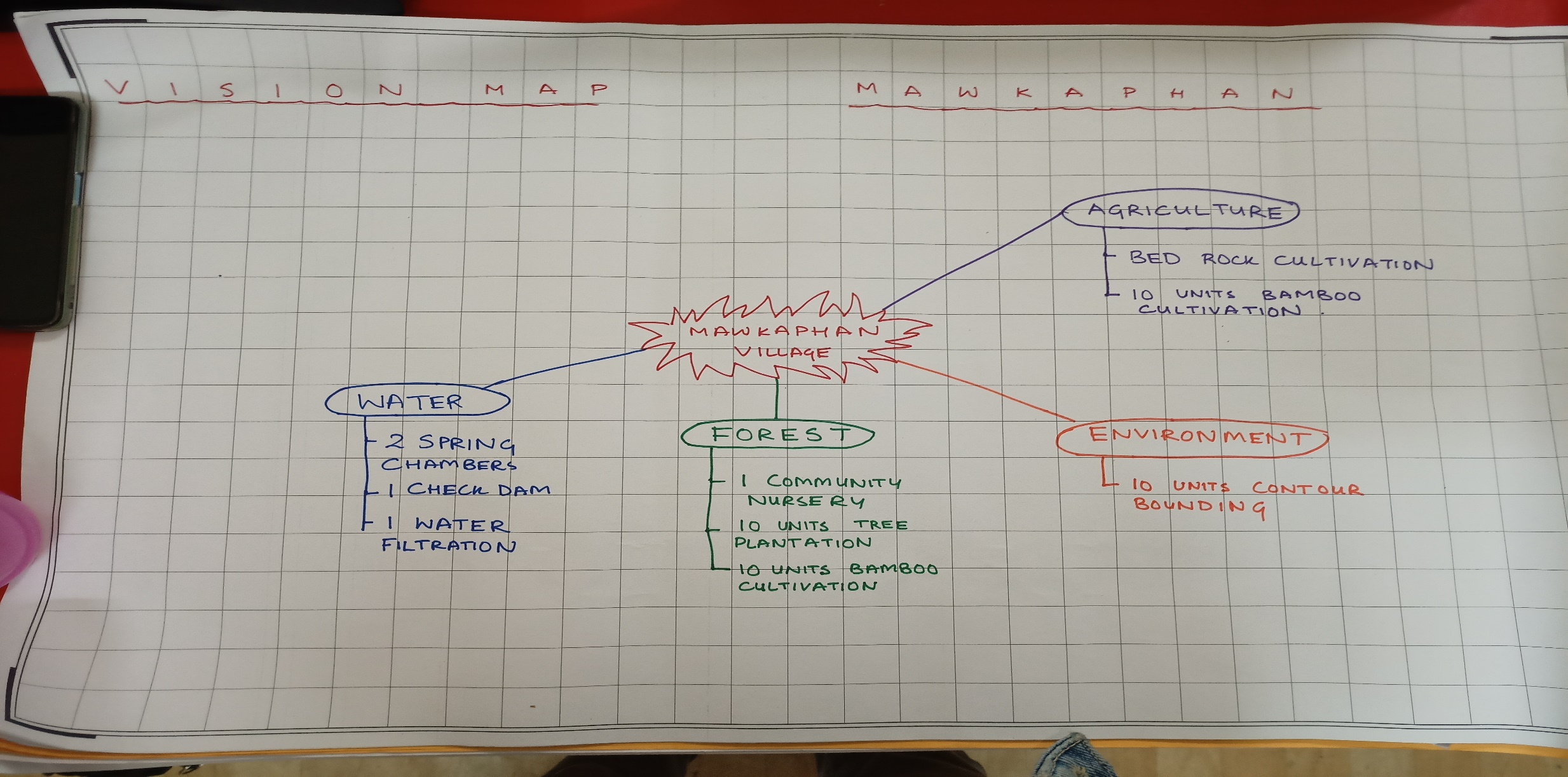 This vision chart can be a
basis to start the next set of discussion, on prioritization of
interventions and be a reference document to help plan under the
project.
This vision chart can be a
basis to start the next set of discussion, on prioritization of
interventions and be a reference document to help plan under the
project.
6.2 Prioritization Exercise
The exercise should build on the resource map and baseline information collected to arrive at potential interventions and initiatives the community would like to plan to achieve their vision for improvements in the state of natural resources of their village.
Group Discussion - Groups of different age groups such as youth men, youth women, men above 30, women above 30 years old.
Facilitate each group to discuss the pressures and challenges related to natural resources in the village, existing best practices and knowledge within the village and then envision improvements that could enhance the state of natural resources and contribute to an improved resource base.
Facilitate them to prioritize new interventions and initiatives to achieve these improvements. Map out the proposed interventions and initiatives using the resource map and write up the interventions in a tabular format
Copy the Vision map on paper for purpose of record and attach the group discussion points of different groups. The list of participants of each group may be attached for future reference.
Geo-tag intervention sites, take photos of sites during the planning stage to compare through the cycle of intervention.
6.3 Intervention identification
| Area of Intervention | Soil & Water Conservation | Land Productivity Enhancement | Spring Shed Development | Afforestation/ Community Forestry Activities | Capacity Building | Others | Remarks on Any Traditional Knowledge/ Best Practice within the Village | |
|---|---|---|---|---|---|---|---|---|
| Intervention 1 | Activity/ Site | |||||||
| Intervention 2 | Activity/ Site | |||||||
| Intervention 3 | Activity/ Site | |||||||
| Intervention 4 | Activity/ Site | |||||||
| Intervention 5 | Activity/ Site | |||||||
| Intervention 6 | Activity/ Site | |||||||
| Intervention 7 | Activity/ Site |
*Note: Consider following criteria for prioritizing the water sources for intervention:
a) Number of dependent households b) Discharge level c) Demand vs Supply Gap d) Drastic change in discharge e) Availability of Land for intervention f) Willingness of communities/individuals
For prioritized springs, fill and attach Annexure-B (Spring Information Form)
|
Name of Proposed Interventions | Site |
|
Nos of HHs expected to Benefit | Priority (High/ Medium/ Low) | Start date (MM/YY) | Completion date (MM/YY) | ||
|---|---|---|---|---|---|---|---|---|---|
|
|
|
|||||||
| 1 | Spring Chamber | Sder |
|
|
|||||
| 2 | Spring Chamber | Mawia |
|
|
|||||
| 3 |
|
Khreng |
|
|
|||||
| 4 |
|
Rngoi | Community |
|
|||||
| 5 |
|
Jymmu |
|
|
|||||
| 6 |
|
Mawbniat |
|
|
|||||
| 7 |
|
|
|
||||||
| 8 |
|
|
|
||||||
| 9 |
|
|
|
||||||
6.5 Training and Capacity Building for implementing CNRM Plan
Sl
|
Type of Training/ Cap Building Activity | No of People | Target audience (VCF/VNRMC) | Proposed frequency | Remarks | ||
|---|---|---|---|---|---|---|---|
| 1 | Training on Solid Waste Management | No training was imparted as yet | |||||
| 2 | Training on Gender inclusion | No training was imparted as yet | |||||
| 3 | Training on Landscape Management | No training was imparted as yet | |||||
| 4 | Social Management and Community Mobilization | No training was imparted as yet | |||||
| 5 | Soil and Water Conservation | No training was imparted as yet | |||||
| 6 | Land Productivity Enhancement | No training was imparted as yet | |||||
| 7 | Forestry and Agroforestry | No training was imparted as yet | |||||
| 8 | Community Nursery and Nursery Management | No training was imparted as yet | |||||
| 9 | Spring Shed Management and Development | No training was imparted as yet | |||||
| 10 | Other training required (please specify) | No training was imparted as yet | |||||
6.6ENVIRONMENT ELIGIBILITY SCREENING
| Sl. No | Activities/Subprojects with any of the attributes listed below will be ineligible for support under the proposed project due to environmental implications. | Yes/No |
|---|---|---|
| 1 | Any subproject/activities that is not consistent with Acts of GoI and GoM | No |
| 2 | Subproject/activities that could intervene or damage/fragment and/or adversely affect/ impact natural habitats/ protected areas, reserve forests, including but not limited to, the following sites:
|
No |
| 3 | Subproject/activities that support forest harvesting on a large/industrial scale | No |
| 4 | Activity that involves construction of check dam >3m height | No |
| 5 | Subprojects/activities that promote or require pesticides that falls in WHO classes IA, IB, or II and/or procurement of large amount of pesticides or toxic agro-chemicals. | No |
| 6 | Subprojects/activities will not support large- scale clearing of land, dredging of water bodies, undercutting of slopes, replacement of natural vegetation that may cause permanent, irreversible impacts. | No |
| 7 | Any activity that has a significant potential of causing forest fires | No |
| 8 | Any project activity that leads to large-scale soil erosion and siltation of water bodies | No |
| 9 | Any activity that promotes or involves incidence of child labour. | No |
| 10 | Sub project/Activities that would adversely affect cultural sites, places of significance importance and protected historical assets (both living and built) | No |
| 11 | Sub project/Activities that involves the felling of the ‘prohibited trees’ without a permit | No |
| 12 | Sub project/Activities that seeks to impose restrictions or loss of access to using natural resources, including medicinal plants or those of economic value for livelihoods. | No |
| 13 | Any activities involving use of Asbestos Containing Materials (e.g. Pipes for community irrigation schemes). | No |
If Yes- reject /modify activities in the plan to meet the criteria.
6.7 ENVIRONMENTAL REGULATORY COMPLIANCE SCREENING
| S. No. | Regulatory requirements | Implications for project | |
|---|---|---|---|
| I | Are any of the activities located within a notified Eco Sensitive Zone (ESZ)?
If yes, Are any of the activities on the list of activities regulated in ESZ? If yes, Has the required permission been taken? |
No No No |
|
II III |
Are any of the activities involving construction located between 100-300 meters from an archaeological site/monument. If yes, has permission been taken from the Archaeological Survey of India? |
No No |
Follow EGs on Chance find procedures |
IV V |
Do any of the activities require license under the Fertilizer Order 1985 (selling, stocking, exhibiting for sale or distribution of bio-fertilizers and organic fertilizers)? If yes, has the license been taken? |
No No |
Follow General Rules under Fertilizer Order 19851 |
6.8 Social Screening Checklist
LAND MANAGEMENT2
| Screening Questions | Yes | No | Details/Remarks | |
|---|---|---|---|---|
| 1. | Is there land requirement under each proposed intervention? | Yes | What is the size of land required per intervention? Who owns the land (Community, Clan or Private) |
|
| 2. | Does the land selected ensure minimum adverse impact? | Yes | ||
| 3. | Is there any impact on: | Provide number of affected persons per intervention | ||
| Agricultural land | Yes | Land development activity will increase the productivity and also reduce soil erosion | ||
| Forest land | Yes | Will increase the forest cover within the village | ||
| Access to common resource (mention type of resource) | Yes | |||
| 4. | Are the estimated affected persons from the vulnerable category? | Yes | Provide number of affected persons per intervention | |
| Women headed HH | Yes | Will get fuel wood & timber from afforested area as well as water from the spring | ||
| BPL HH | Yes | Will get fuel wood & timber from afforested area as well as water from the spring | ||
| 5. | Will land be taken on voluntary land donation? | Yes | ||
| 6. | Have the principles and procedures3 for voluntary land donation been duly followed? | No | ||
| 7. | Have due precautions been taken to minimize disturbance to sensitive locations or locations having cultural significance? | NA |
SOCIAL INCLUSION4
| Screening Questions | Yes | No | Details/Remarks | |
|---|---|---|---|---|
| 1. | Was separate consultation held with different groups? | No | Mention type of interaction and location | |
| Women | Yes | |||
| Youth | No | |||
| Low income families | No | |||
| Minority groups | No | |||
| Any other | No | |||
| 2. | Are the concerns and priorities of different groups reflected in the interventions proposed? | No | List the specific concern | |
| Women | Yes | Water for drinking and domestic purpose | ||
| Youth | Fuel wood | |||
| Low income families | Timber for construction of house | |||
| Minority group | ||||
| Any other | ||||
| 3. | Were separate meetings with women organised to prioritise their needs? | No | ||
| 4. | What percentage of women are members of local committees formed under the project? | VNRMC- 50%, Purchase Committee - 67 % | ||
| 5. | Number of women are employed under the project? (provide total number at each level and the total staff to calculate the percentage of women) |
Staff, consultants, field workers | ||
| State | Meghalaya | |||
| District | East Khasi Hills | |||
| Block | Mawkynrew | |||
| Village | Umkhoi |
LABOUR MANAGEMENT
| Screening Questions | Yes | No | Details/Remarks | |
|---|---|---|---|---|
| 1. | What are the number of labour required under the interventions proposed? | Yes | Number of labour/number of days | |
| 2. | Is labour influx5 expected? | No | ||
| 3. | Is an assessment on impacts due to labour influx required? | No | Specify the reason for Yes or No | |
| 4. | Does the project ensure that no activity will involve child labor? | Yes | ||
| 5. | Does the project ensure equal opportunities and wage to female workers as per applicable acts? | Yes | Based on the MGNREGS | |
| 6. | Are there any contractors to be engaged? | No | ||
| 7. | Do contractor agreements contain clauses for labour protection and insurance6? | |||
| 8. | Is there any GRM for labour related issues? | No |
CITIZEN ENGAGEMENT
| Screening | Yes | No | Details | |
|---|---|---|---|---|
| 1 | Is there communication material available? | Yes | Pamplets, posters, GRM stickers | |
| 2 | Is the communication material available in local language? | Yes | Pamplets, posters, GRM stickers | |
| 3 | Are multiple mediums used to share information at the village level? | Yes | Powerpoint Presentation, Photos, Examples of various NRM, Videos | |
| 4 | Are meetings organised at village level? | Yes | Awareness programme, CNRMP preparation, Follow up meetings | |
| 5 | Are people informed in advance of the meetings? | Yes | Through letter and telephonic conversation with the village representatives | |
| 6 | Are citizen’s needs documented? | No | ||
| 7 | Are CNRMPs consolidation of people’s needs? | Yes | ||
| 8 | Is information on CNRMP displayed in the village? | No | (please provide a list of what and where) | |
| 9 | Is there a GRM system? | No | During Awareness and Sensitisation program and sharing of phone number | |
| 10 | Is the GRM system advertised? | Yes | During Sensatisation and a Project poster with contact number if there is any complaint | |
| 11 | Are people aware of it? | Yes |
BENEFIT SHARING
(to be filled for each intervention):
| 1 | Name of the Intervention | |
|---|---|---|
| 2 | Number of Direct Beneficiaries | |
| 3 | Overall Quantum of Benefit | |
| 4 | Distribution of benefit per HH | |
| 5 | Contribution (What is each HH contributing) |
|
| 6 | Number of Indirect Beneficiaries |
6.9 Preparation of Estimate and Budget by Technical Assistants/ Engineers
(Based on the technical feasibility, scope and scale of interventions identified a budget and estimate needs to be prepared for the plan that receives technical sanction by technical experts/ block level engineers)
| S No | Intervention (Area and no. of units) | Estimated Total Cost (INR) | Yearly Budget | Source of Funding | Remarks | ||||
|---|---|---|---|---|---|---|---|---|---|
| Y1 ____ | Y2____ | Y3____ |
|
Govt Scheme | Others | ||||
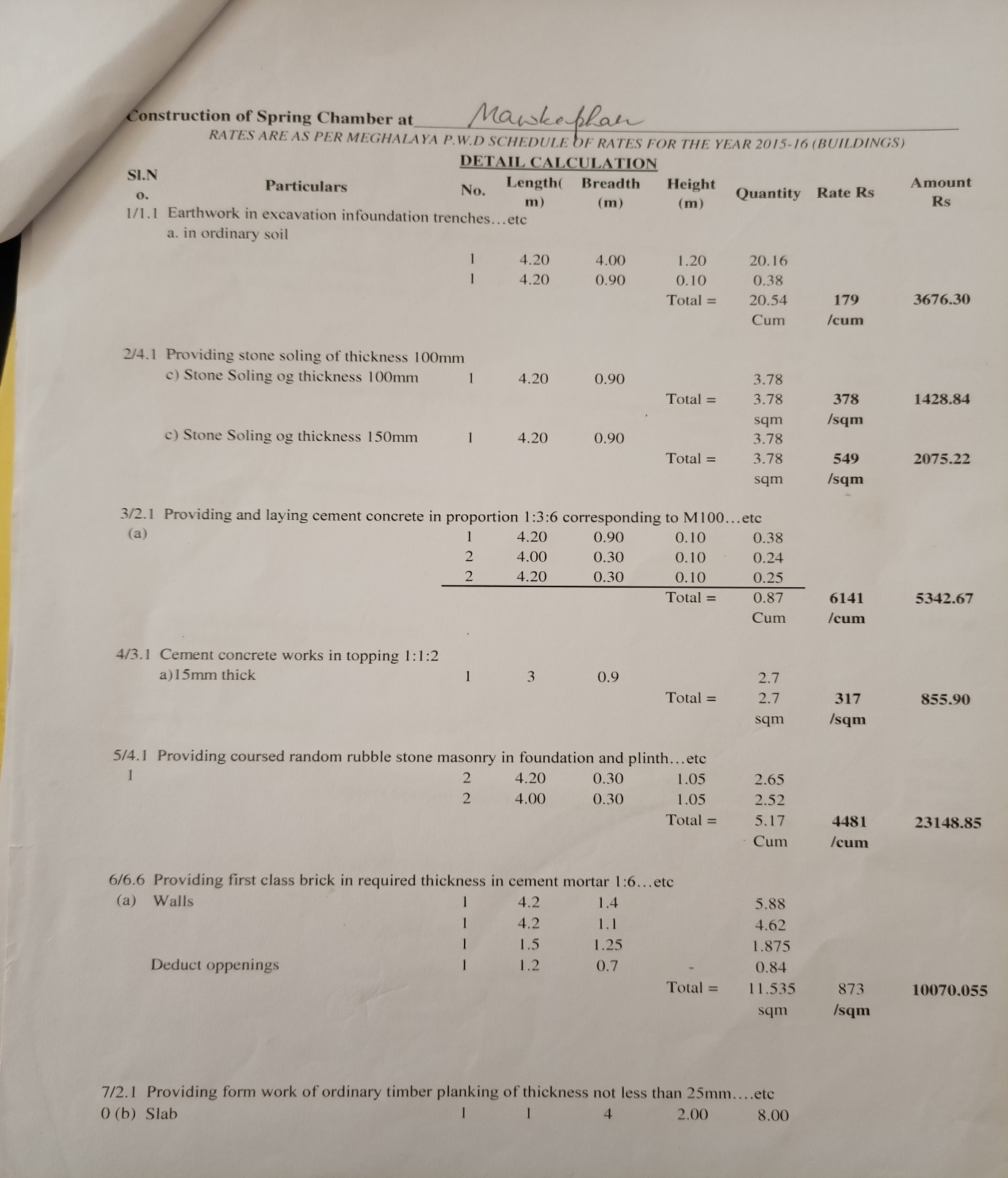
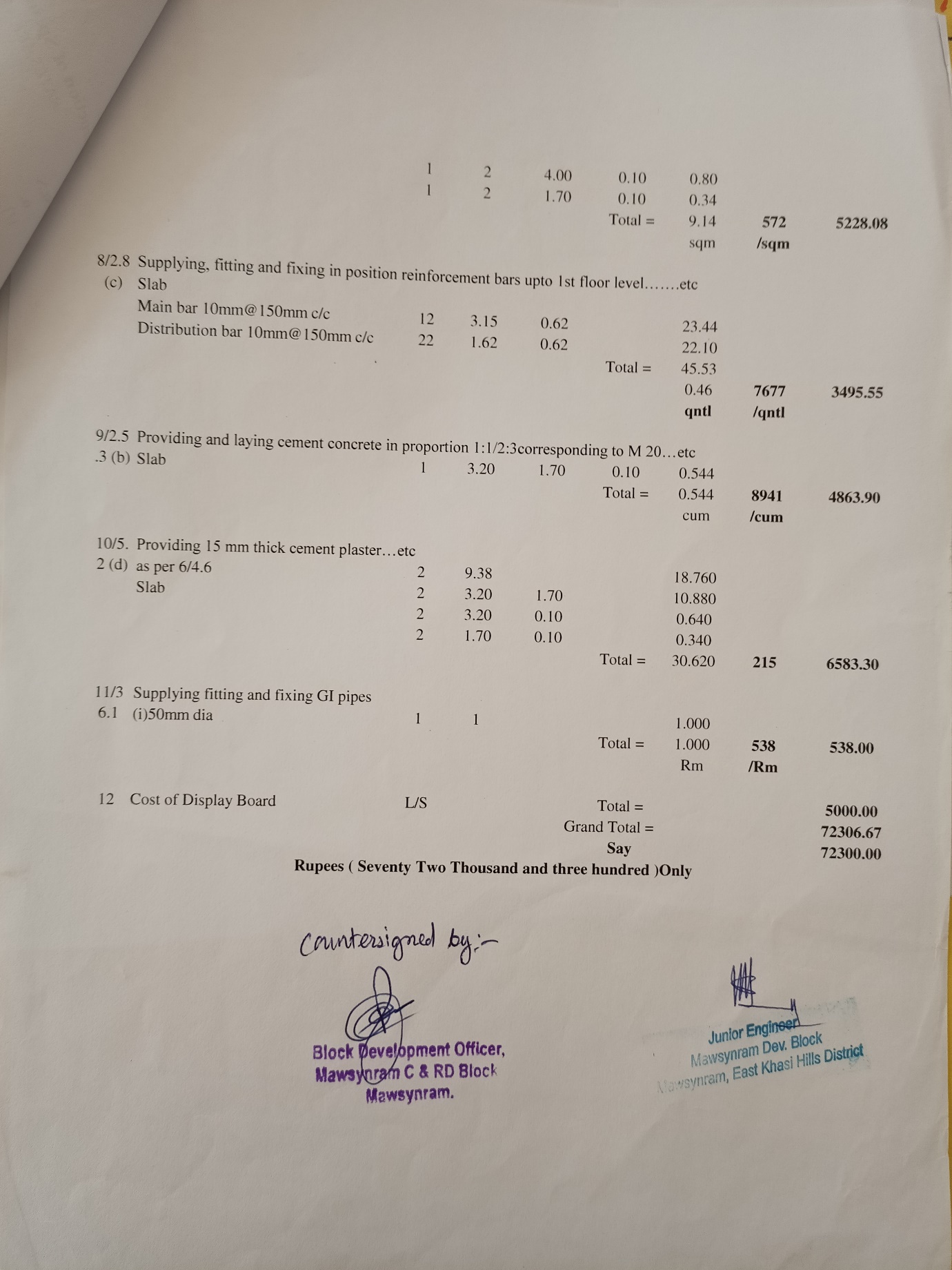
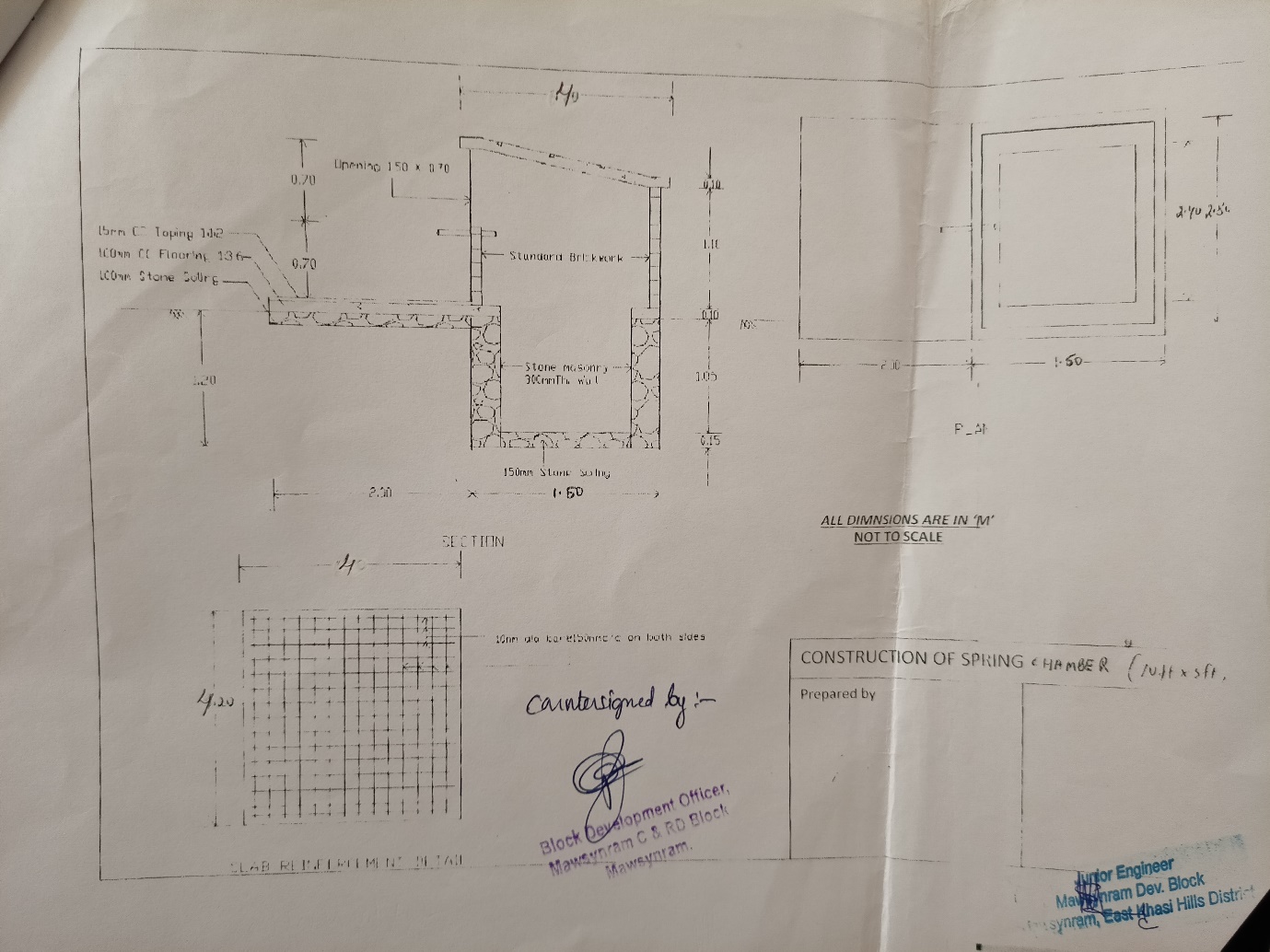
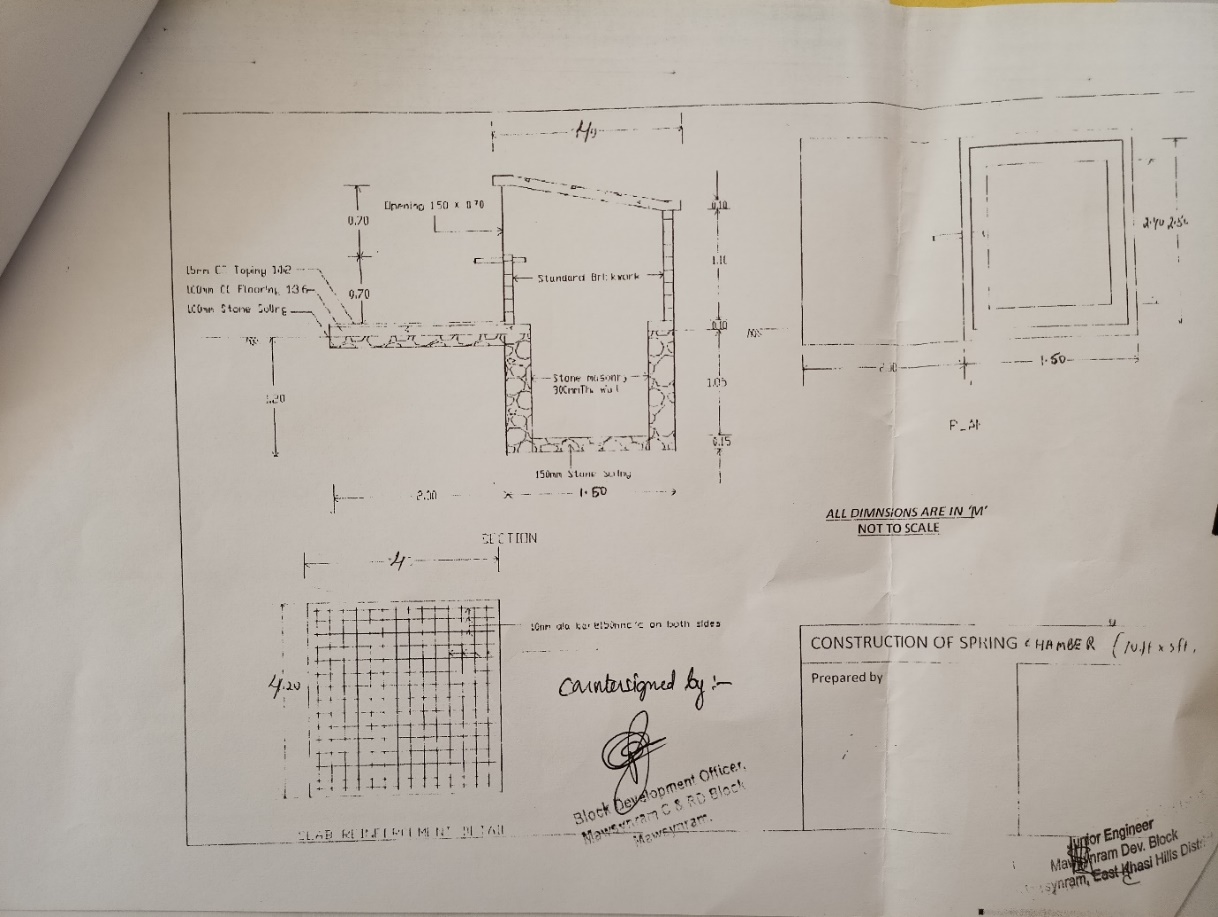
| 1 | Construction Of Spring Chamber |
|
|
|
|||||
| 2 | Construction of Check Dam |
|
|
||||||
7. Community Natural Resource Management Plan Checklists (to be submitted)
List of participants (ensure participation of women and vulnerable groups)
Completed CNRM booklet
Resource Map
GPS Coordinates and maps of village area, different forest cover, springsheds, water bodies, catchment areas etc for generating Satellite images of different GIS layers of villages as required)
Summary of Village CNRM Plan with community estimate/ Budget
Checklists: Eligibility Screening Checklist, Regulatory Compliance Screening form, Social Screening Checklist
Photos of Resource mapping exercise, group discussions, proposed intervention areas
General Observation/Remarks of the Facilitators on the Village:
(Comment on number and composition of participants/ Any challenges/ feedback etc)
………………………………………………………………………………………………………………………………………………………………………………………………………………………………
……………………………………………………………………………………………………………………………………………………………………………………………………………………………………………………………………………………………………………………………………………………………………………………………………………………………………………………………………………..
Name of Facilitator:………………………….…………………………………… Designation:……………………………………………… Signature and Date:………………………………..
Name of VNRMC Chairperson/Secretary..................................Designation:……………………………………………… Signature and Date:………………………………..
Name of Technical Assistant……………………………………………………Designation:………………………………………………Signature and Date:………………………………..
Annexure – A
Water Budgeting
| S No | Parameter | Response | |||||||||||||||||||||||||||
|---|---|---|---|---|---|---|---|---|---|---|---|---|---|---|---|---|---|---|---|---|---|---|---|---|---|---|---|---|---|
| 1 | Total Number of Households | 78 | |||||||||||||||||||||||||||
| 2 | Total Population | 410 | |||||||||||||||||||||||||||
| 3 | Average Population per Household | 5.26 | |||||||||||||||||||||||||||
| 4 | Total Livestock (HH) | 59 | |||||||||||||||||||||||||||
| DEMAND | Spring (Mar-Apr) | Monsoon (May-Sept) | Autumn (Oct-Nov) | Winter (Dec-Feb) | |||||||||||||||||||||||||
| Water Demand per capita per day (Human use) | Government Noms Based | ||||||||||||||||||||||||||||
| Water Demand per capita per day (Livestock) | |||||||||||||||||||||||||||||
| Total Demand per day (litres)-Human | |||||||||||||||||||||||||||||
| Total Demand per day (litres)-Livestock | |||||||||||||||||||||||||||||
| Total Demand per day (liters) (Human+Livestock) | |||||||||||||||||||||||||||||
| Time Spent for fetching water per Household per day (in minutes) | |||||||||||||||||||||||||||||
| Total Supply per day (litres) | |||||||||||||||||||||||||||||
| Difference | |||||||||||||||||||||||||||||
| Difference Per Capita Per day | |||||||||||||||||||||||||||||
| SUPPLY | Spring (Mar-Apr) | Monsoon (May-Sept) | Autumn (Oct-Nov) | Winter (Dec-Feb) | |||||||||||||||||||||||||
| 1 | Water sources | Available in numbers | Distance from village Community hall (average) | Purpose Used for: Drinking-1 Domestic-2 Animals-3 |
Sum of average discharge of all utilised springs (lpm) or Water Levels in m bgl (meters below ground level) | Total water supply (liters) per day | Sum of average discharge of all utilised springs (lpm) or Water Levels in m bgl (meters below ground level) | Total water supply (liters) per day | Sum of average discharge of all utilised springs (lpm) or Water Levels in m bgl (meters below ground level) | Total water supply (liters) per day | Sum of average discharge of all utilised springs (lpm) or Water Levels in m bgl (meters below ground level) | Total water supply (liters) per day | |||||||||||||||||
| 1 | 2 | 3 | 4 | 5 | 6 | 7 | 8 | 9 | 10 | 11 | 12 | ||||||||||||||||||
| 1.1 | No of Springs | 4 | 53m | 1, 2 | 5.9 lpm | 8496 | |||||||||||||||||||||||
| 1.2 | No of Ponds | 2 | 40m | 3 | 1 m | ||||||||||||||||||||||||
| 1.3 | No of Lakes | 2 | 150m | 3 | 2.5 m | ||||||||||||||||||||||||
| 1.4 | No of Wells | 0 | 0 | 0 | 0 | 0 | |||||||||||||||||||||||
| 1.5 | No of Hand pumps | 0 | 0 | 0 | 0 | 0 | |||||||||||||||||||||||
| 1.6 | Other water supply (PHED, etc) | NA | NA | NA | NA | NA | |||||||||||||||||||||||
| Total | 0 | Total | 0 | Total | 0 | Total | 0 | ||||||||||||||||||||||
Annexure-B
SPRING INVENTORY FORM
|
|||
|---|---|---|---|
| Date & Time | : __________________________________ | ||
| Name of surveyor | : __________________________________ | ||
| State | : Meghalaya | ||
| District | : East Khasi Hills | ||
| Block name | : | ||
| Village name | : | Panchayat: NA | Hamlet: NA |
| Local Spring Name | : | ||
| Spring ID | : (2-aplphabet initials of State/District/block/village/spring number) |
||
|
|||||
|---|---|---|---|---|---|
| Latitude: | Longitude: | Elevation (m): | |||
| GPS Accuracy (m): _______ | No. of Dependent Households: | ||||
|
|||||
| Community ✔ | Private | Forest | Others ________________ | ||
|
|||||
| Contact spring | Karst spring | ||||
| Fault spring | Depression spring | ✔ | |||
| Fracture spring | |||||
| Combination (Please specify) | ______________________________ | ||||
|
|||||
| Seasonal | Perennial | ||||
| If seasonal, period of flow (in months) | _______________ | ||||
| Peak discharge period: ______________ | |||||
|
||||||
|---|---|---|---|---|---|---|
| Springbox/tank/chamber | ||||||
| Using pipe/Bamboo outlet | ||||||
| From a flowing stream | ||||||
| Pipeline system | ||||||
| Flowing from a wetland/water logged area | ||||||
|
||||||
| Dimensions of the box | ||||||
| Length (m): ______________ | Breadth (m): _____________ | Height (m): ____________ | ||||
| Diameter (m): ____________ | Height (m): ____________ (in case of cylindrical tank) | |||||
Other: ______________________________
|
||||||
| Drinking & Cooking | Agriculture | |||||
| Domestic (Washing clothes/utensils, Bathing etc.) | Livestock | |||||
| Community Water Supply | Not Used | |||||
| Other | None | |||||
|
|---|
| Discharge (LPM-Litres Per Minute): _____________ |
| Time and Dateof Discharge measurement: _______________ (hrs:mins, dd/mm/yyyy) |
Using Stop watch - Bucket method
| Volume of container (litre) | Time Taken | Discharge (in litres per minute) lpm | |||
|---|---|---|---|---|---|
| T1 | T2 | T3 | T (average) | ||
Using Water levelrise method
| Surface area of Spring box | Initial depth to water level (D1) (m) | Final depth to water level (D2) (m) | Rise in water level H = D1- D2 (m) | Volume of water increased = L x B x H(m3) | Time taken (mins) | Discharge (in litres per minute) lpm | |
|---|---|---|---|---|---|---|---|
| Length (L) (m) | Breadth (B) (m) | ||||||
In a flowing, channelised stream
| Length (L) (avg.) | Breadth (B) (avg.) | Depth (D)(avg.) | Volume in m3 = L x B x D | Time Taken | Discharge (in litres per minute) lpm | |||
|---|---|---|---|---|---|---|---|---|
| T1 | T2 | T3 | T (average) | |||||
|
|||
|---|---|---|---|
| pH ___________ | TDS (ppm) ________________ | Salinity (ppm) ________________ | |
| Temperature (0C) _____ | Electrical Conductivity (µS/cm) ___________ | ||
| Bacterial Contamination | Yes No | ||
| Water sample collected | Yes No | If Yes, Sample ID: ____________ | |
|
|||
| Jhoom Cultivation | |||
| Terrace Agriculture | |||
| Forest | |||
| Reserved Forest | |||
| Community Forest | |||
| Settlements | |||
| Others if any. Please Mention | ✔. Mostly barren land with no vegetation with rock soil surface | ||
|
|||
| Private | |||
| Community | |||
| Government | |||
| Mixed | |||
| Others, if any, Please Mention | |||
|
|||
| Latrines | |||
| Waste dump | |||
| Gutters | |||
| Open defecation | None | ||
|
|||
| Loose unconsolidated | |||
| Weathered rock | ✔ | ||
| Fractured-vertical | |||
| Fractured-horizontal | |||
| Hard and compact | ✔ | ||
| Other Characteristics (mention if any) | |||
Rocky barren land without any outcrops
|
|
|---|---|
| Dip slope | ✔ |
| Escarpment slope | |
| Vertical slope | |
|
|---|
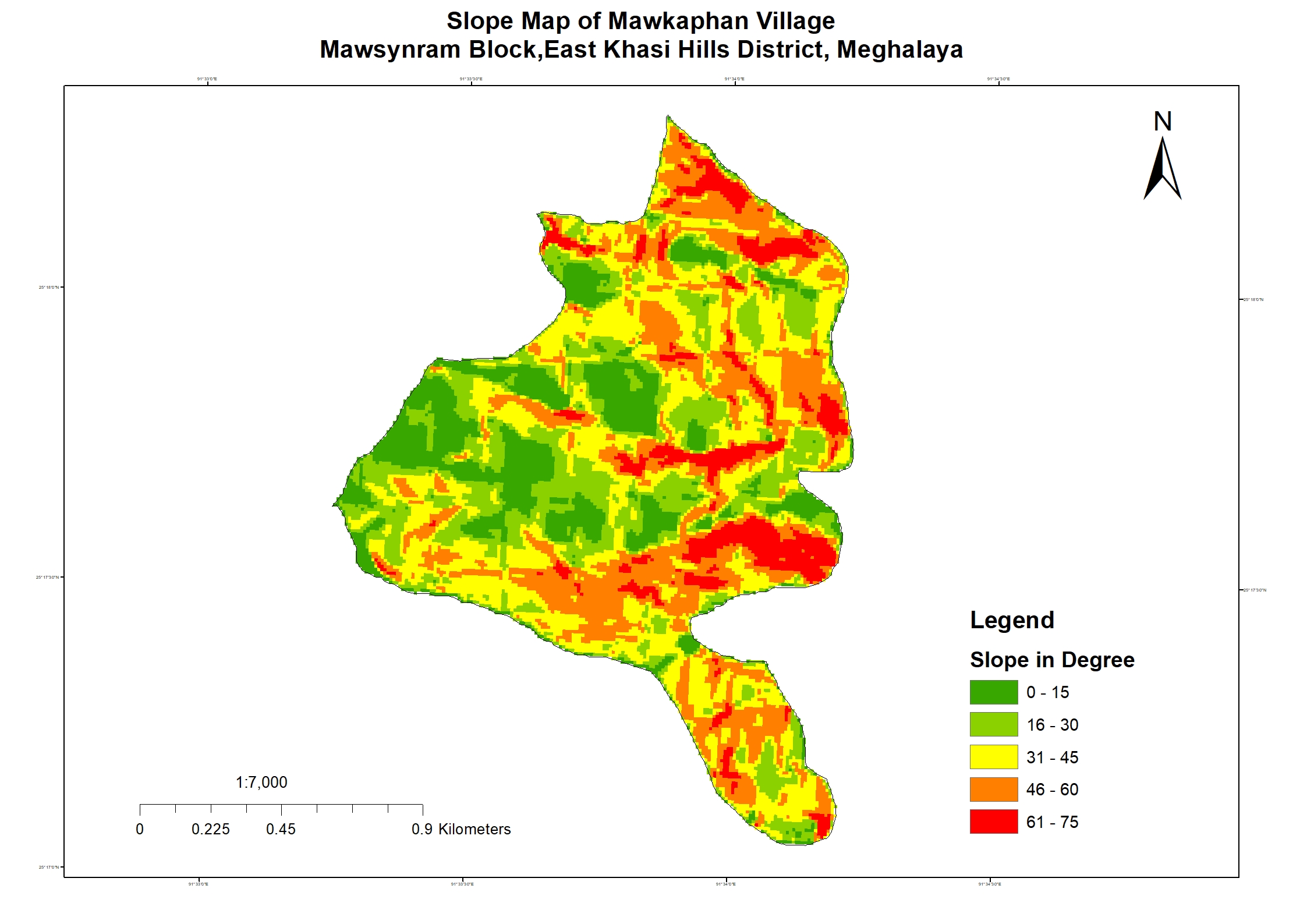
Field sketch of the Spring emergence site
Geological section or 3-D conceptual diagram of the Springshed
Google Earth image of the delineated potential recharge area/zone of the Spring (with specific interventions marked)
Details of the Spring recharge interventions
| Recharge intervention type | Dimensions | Number of plantations/structures |
|---|---|---|
| Social | ||
| Engineering | ||
| Biological |
CLMMP Preparation:
| Sl. No | TYPE OF INTERVENTION WORK | Number of Activities | SITE NAME | GPS COORDINATES | NO. OF WORK ORDER ISSUED | AMOUNT as per ESTIMATE from CLLMP (Rs) |
Convergence Amount (Rs) |
Treatment / Benefited Area (Hectares) |
Household Benefited |
START DATE | COMPLETION DATE | Remarks |
|---|---|---|---|---|---|---|---|---|---|---|---|---|
| 1 | Construction of Spring Chamber | 1 | Mawbniat | 25.29913 91.56655 |
2 | ₹ 28,916.00 | ₹ 43,384.00 | 3 | 98 | 26-08-2019 | 20-10-2019 | |
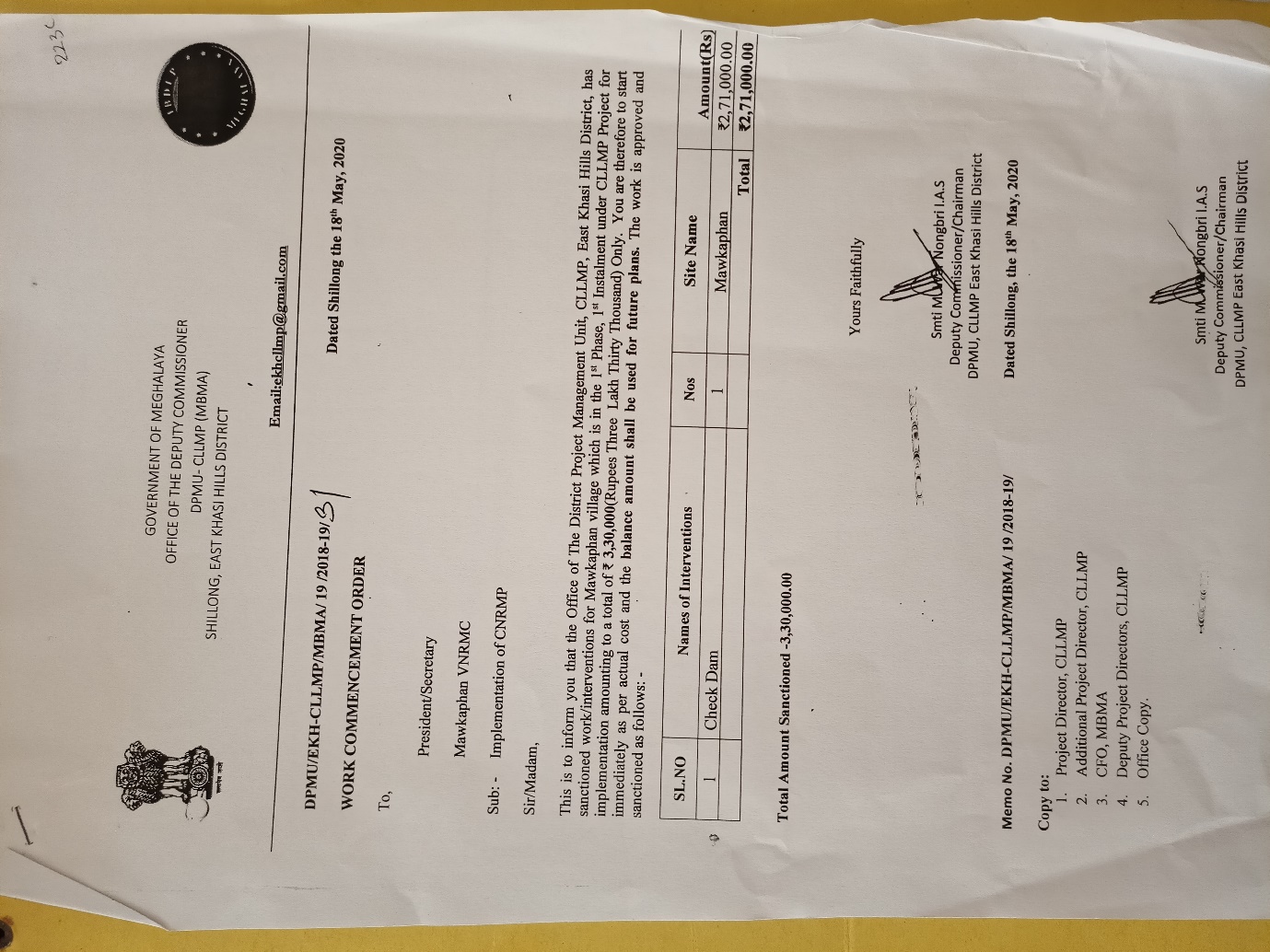
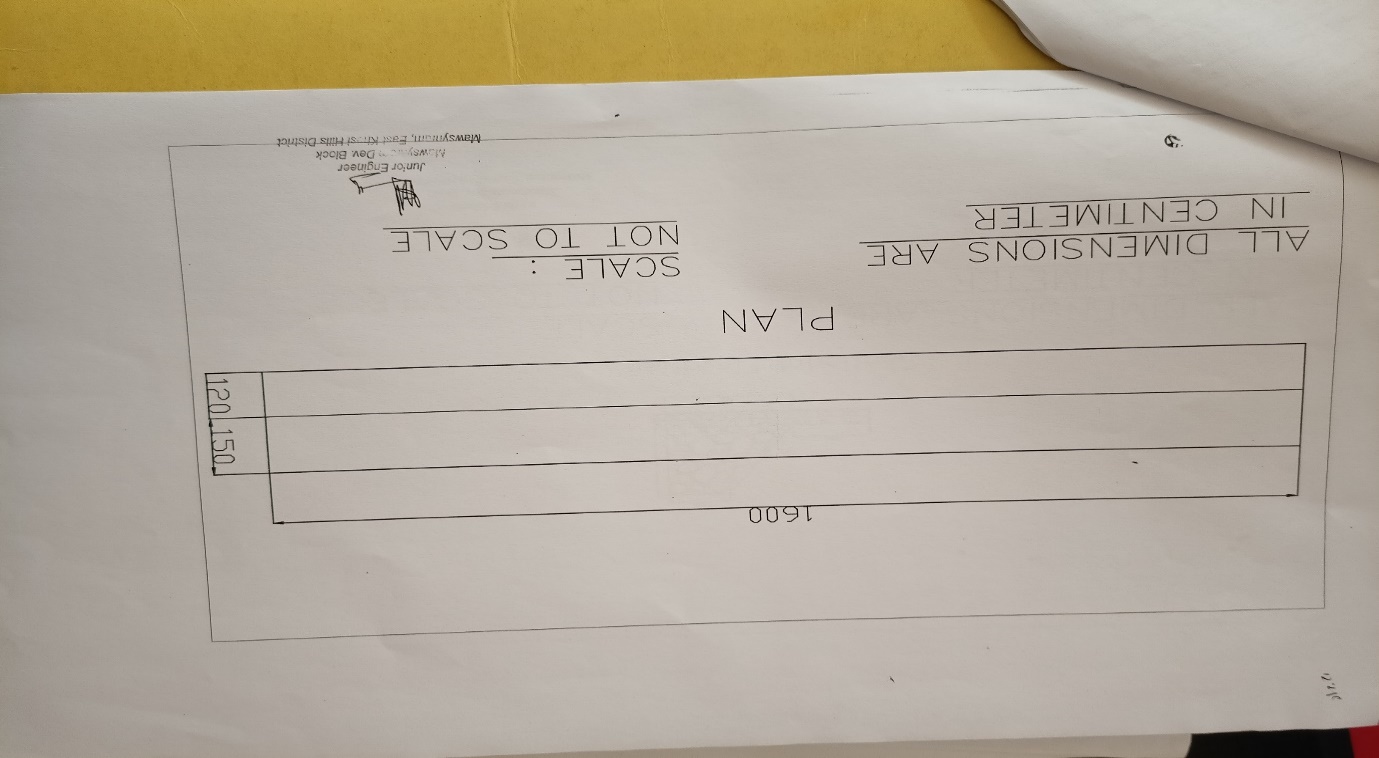
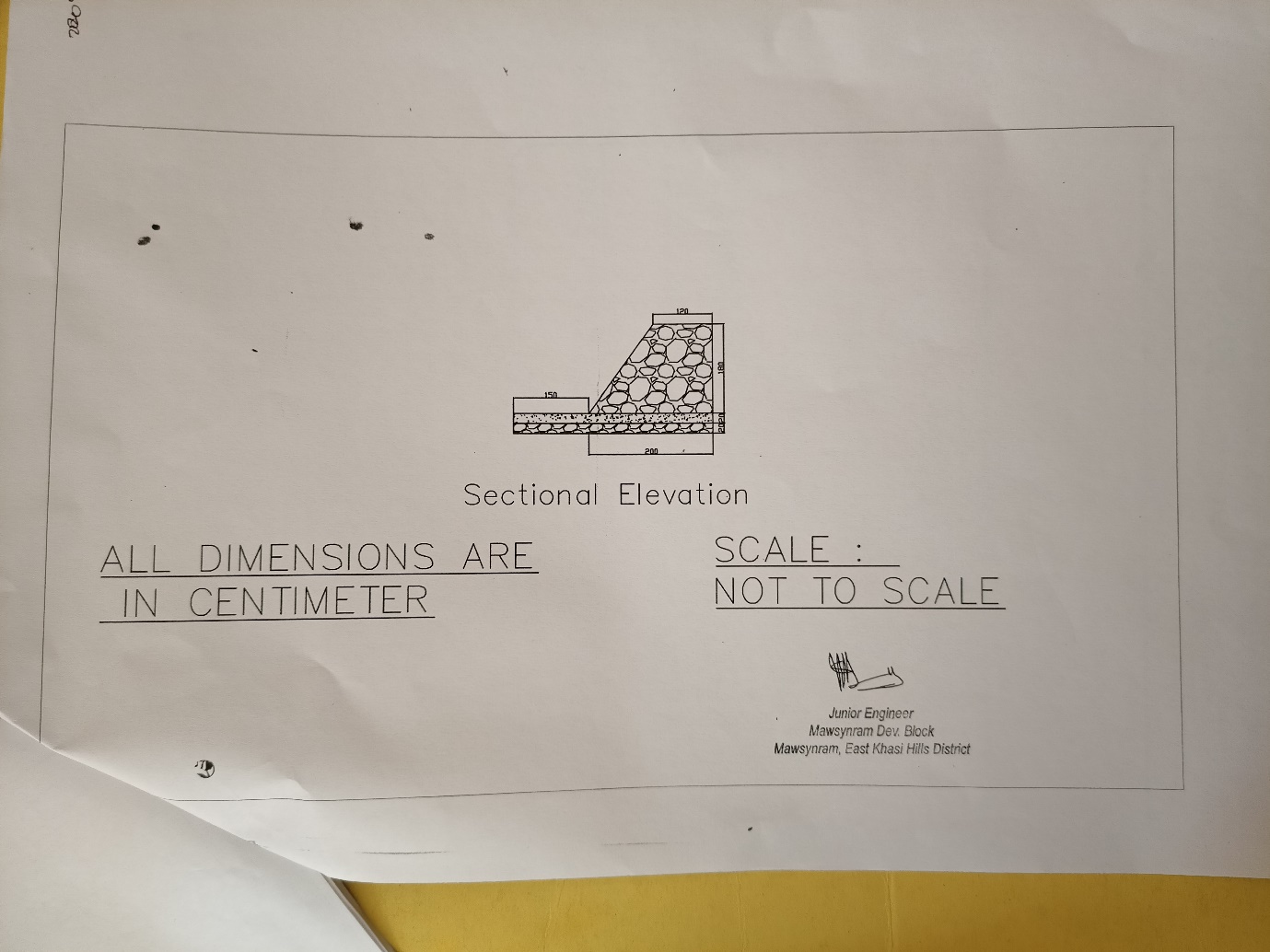
| 2 | Construction of Check Dam | 1 | Mawkaphan | ₹ 2,71,000.00 | N/A | 10 | Not Started |
 PRA
Exercise:
PRA
Exercise:
Inflow and Outflow of Mawkaphan Village
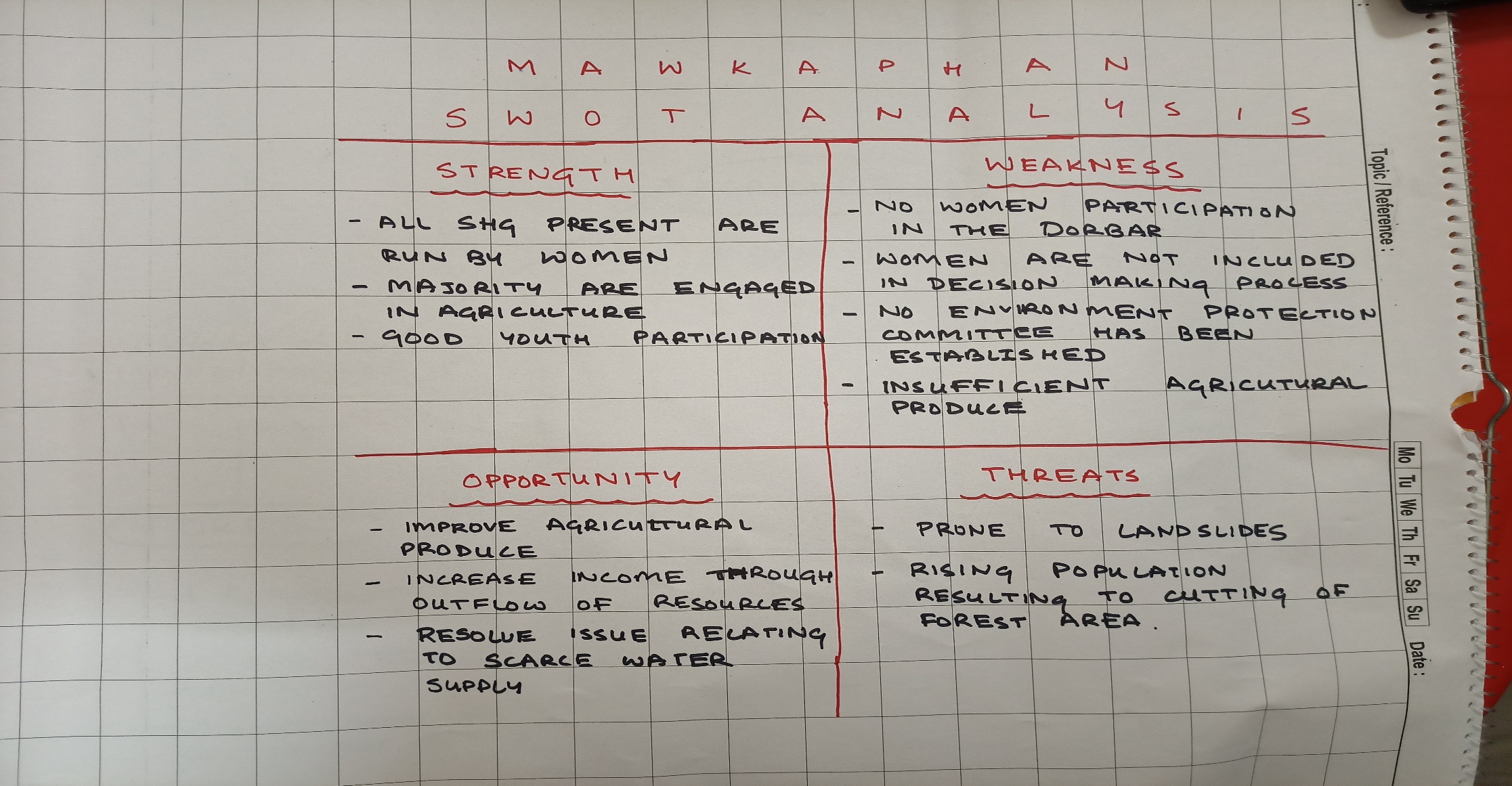 SWOT Analysis of
Mawkaphan Village
SWOT Analysis of
Mawkaphan Village
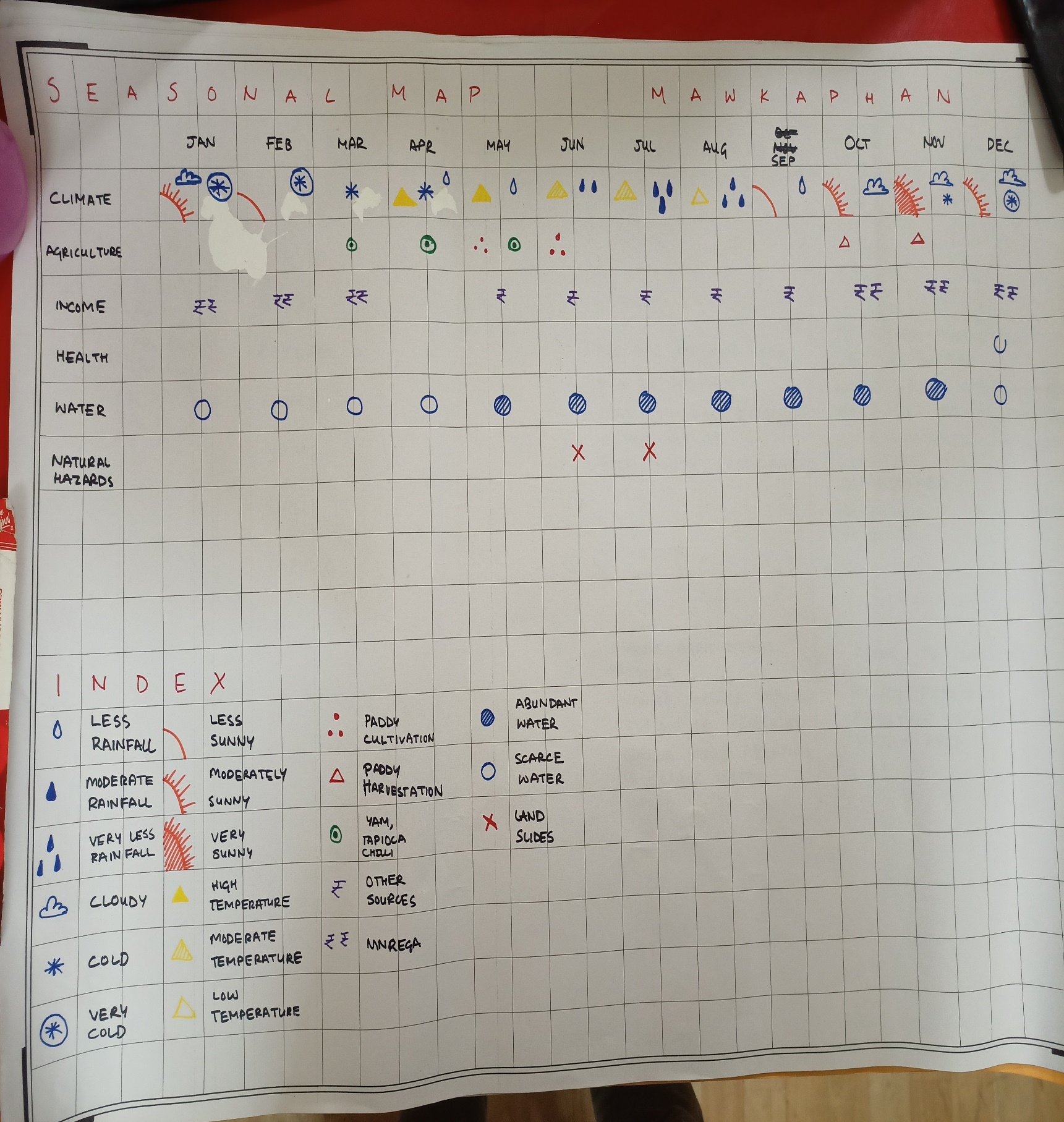
Seasonal Calendar of Mawkaphan Village
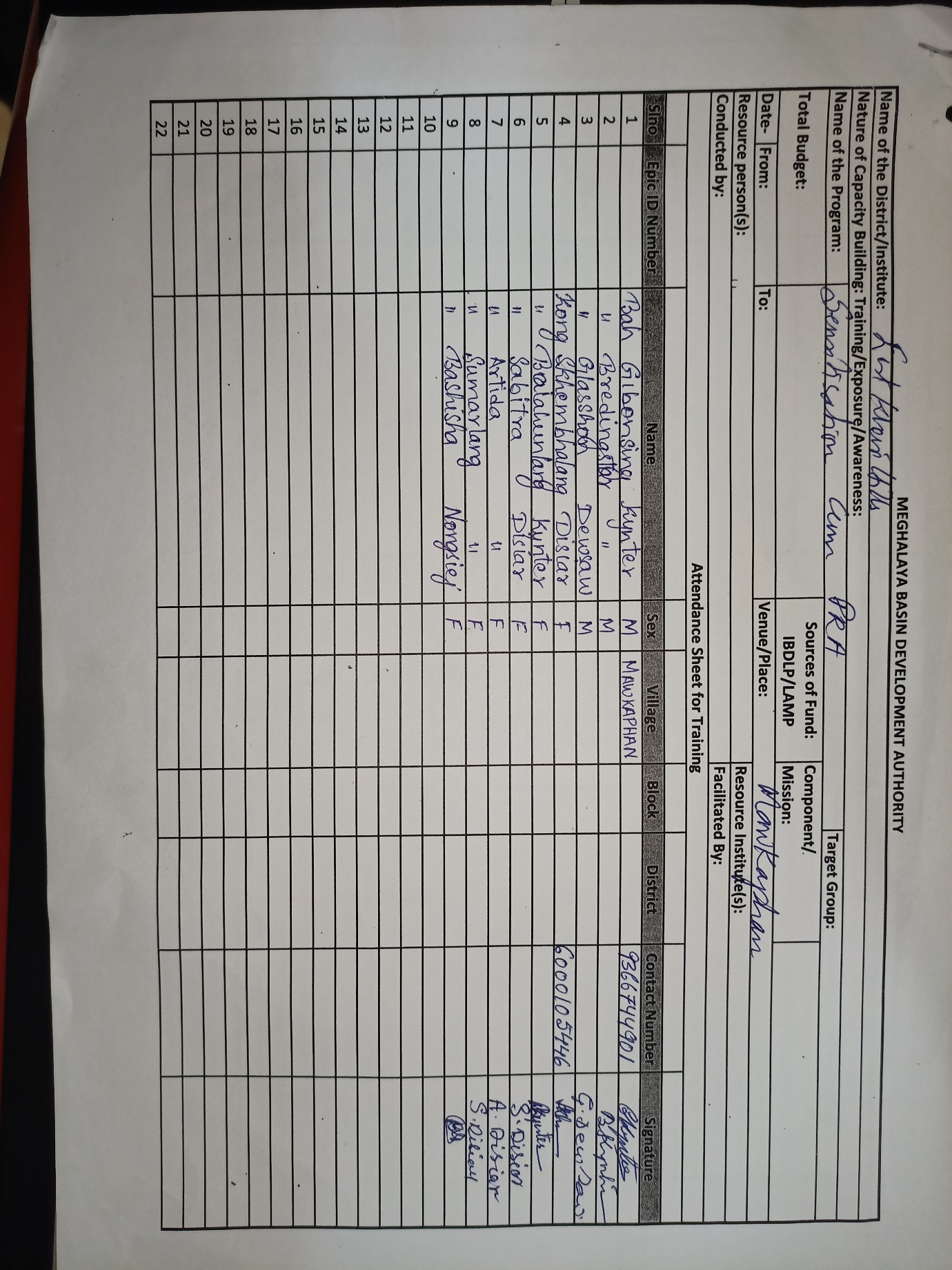 Participant
List:
Participant
List:
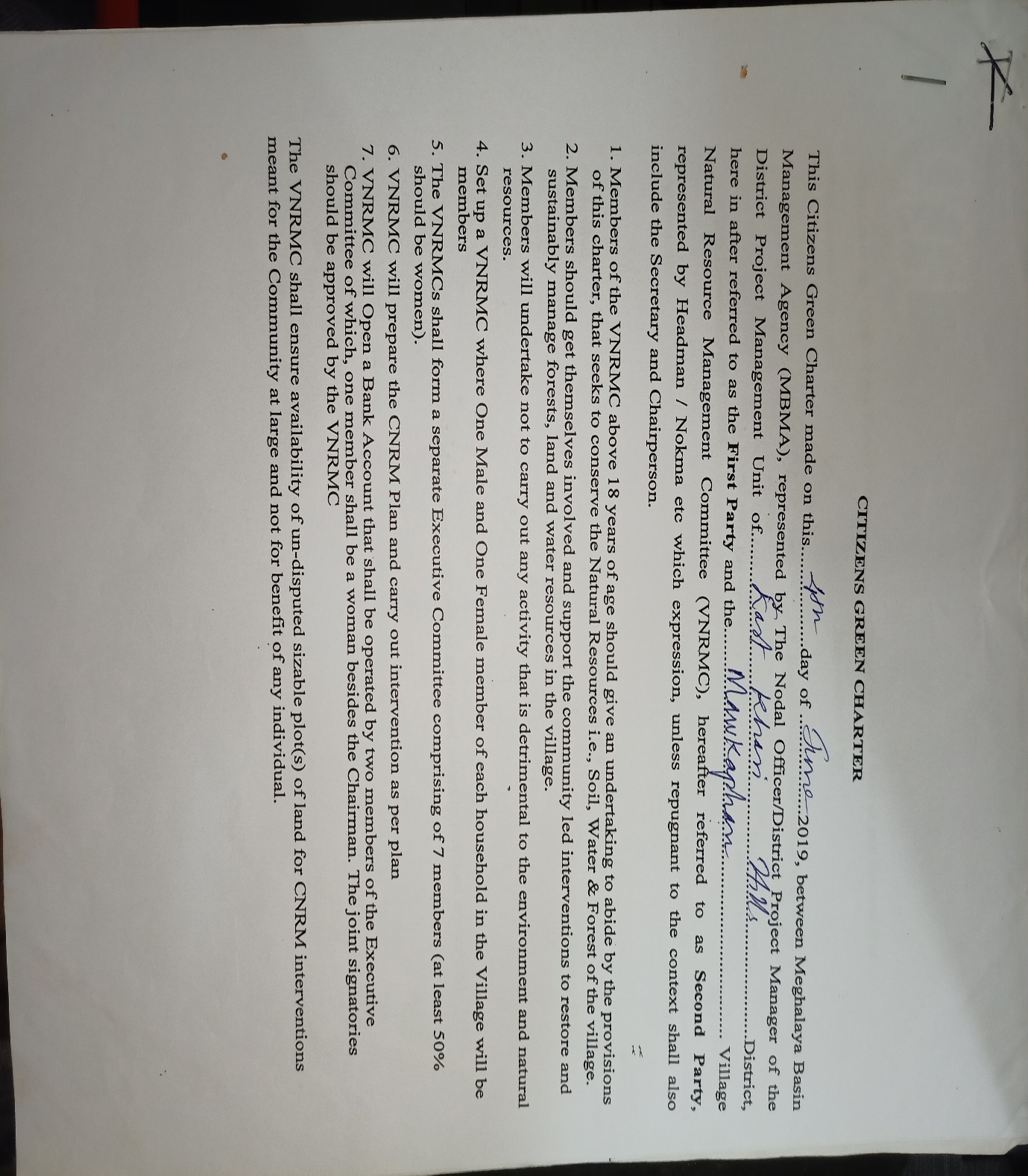 Green
Charter:
Green
Charter:
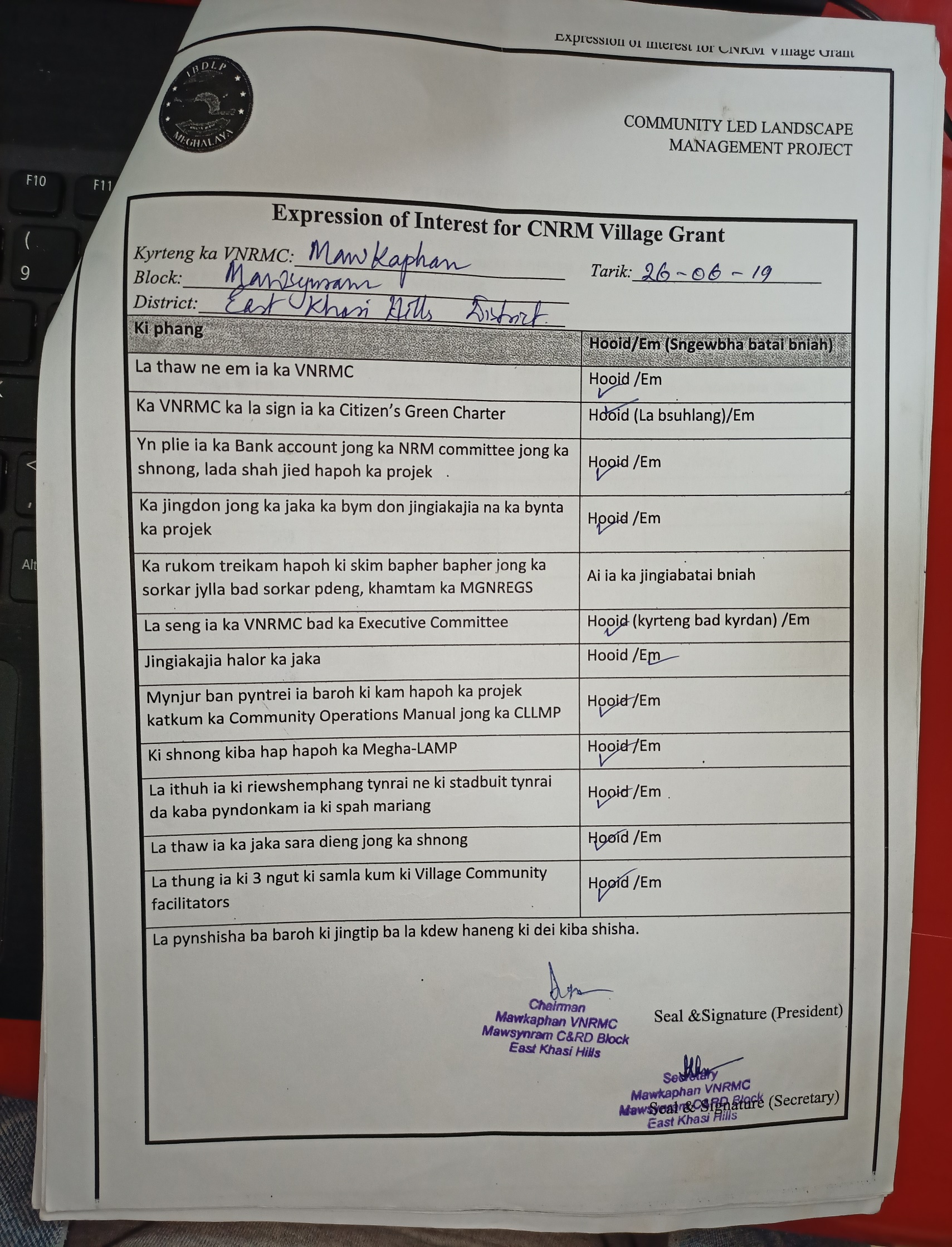 Expression of
Interest:
Expression of
Interest:
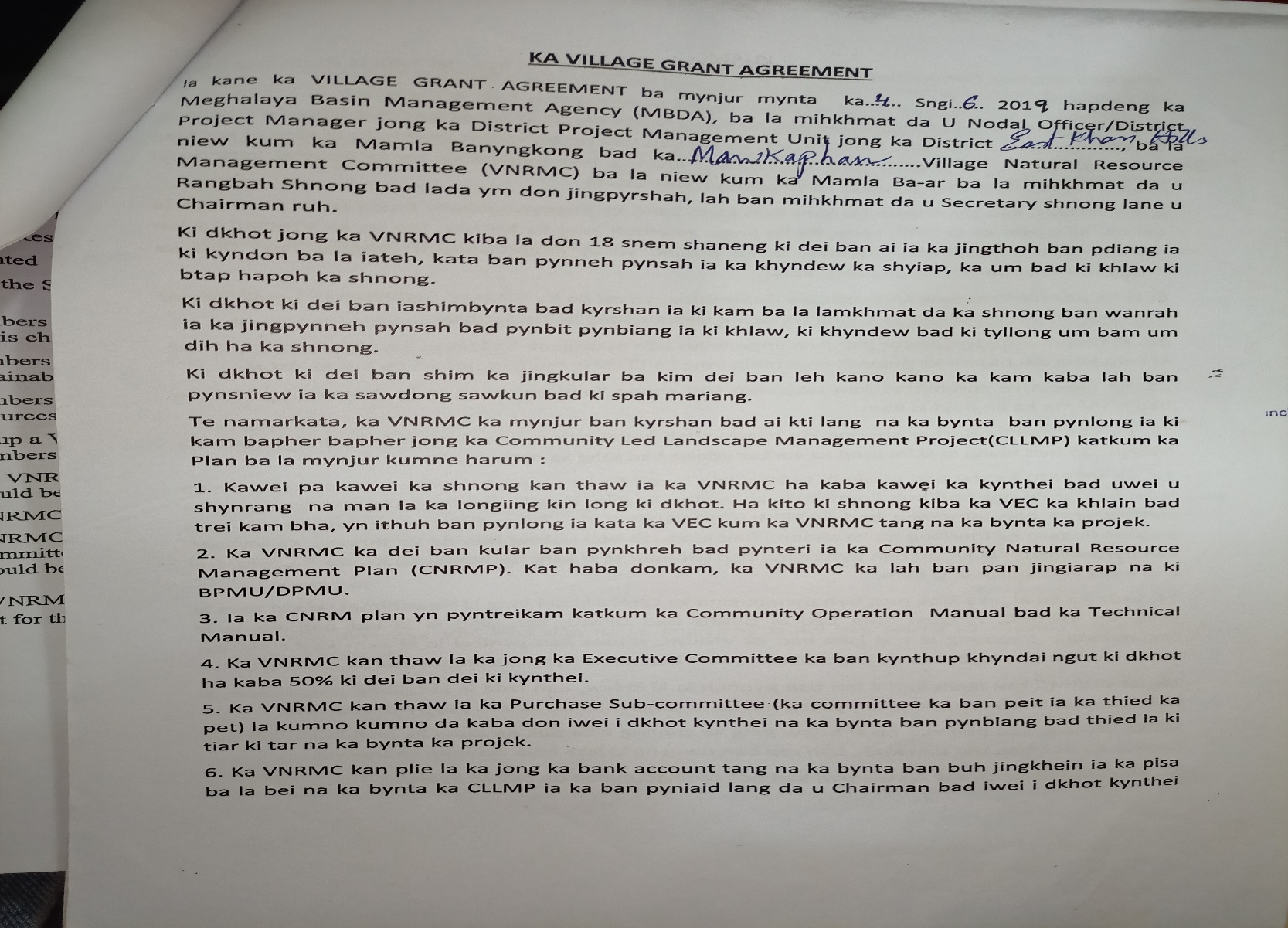 Village
Agreement:
Village
Agreement:
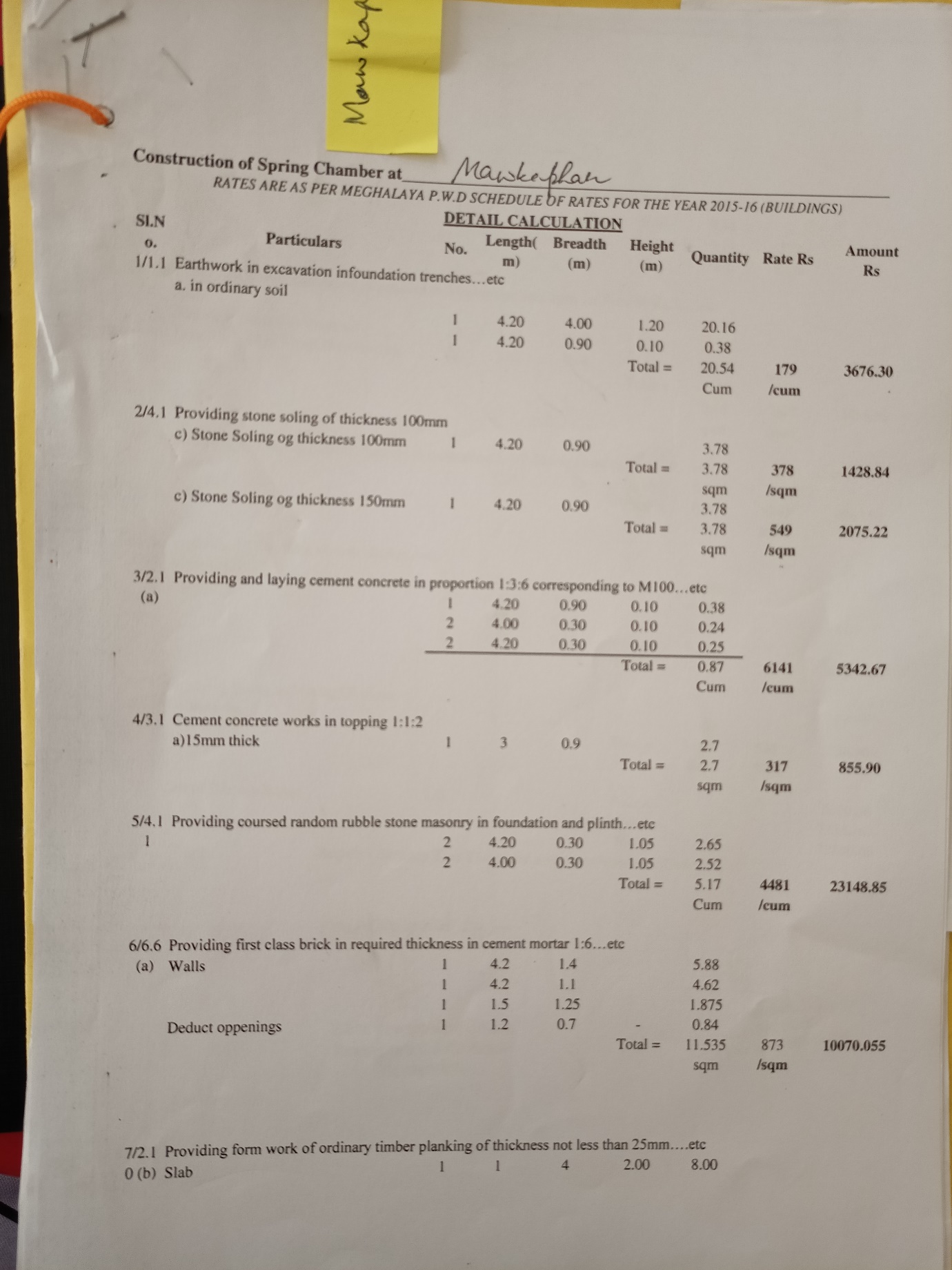
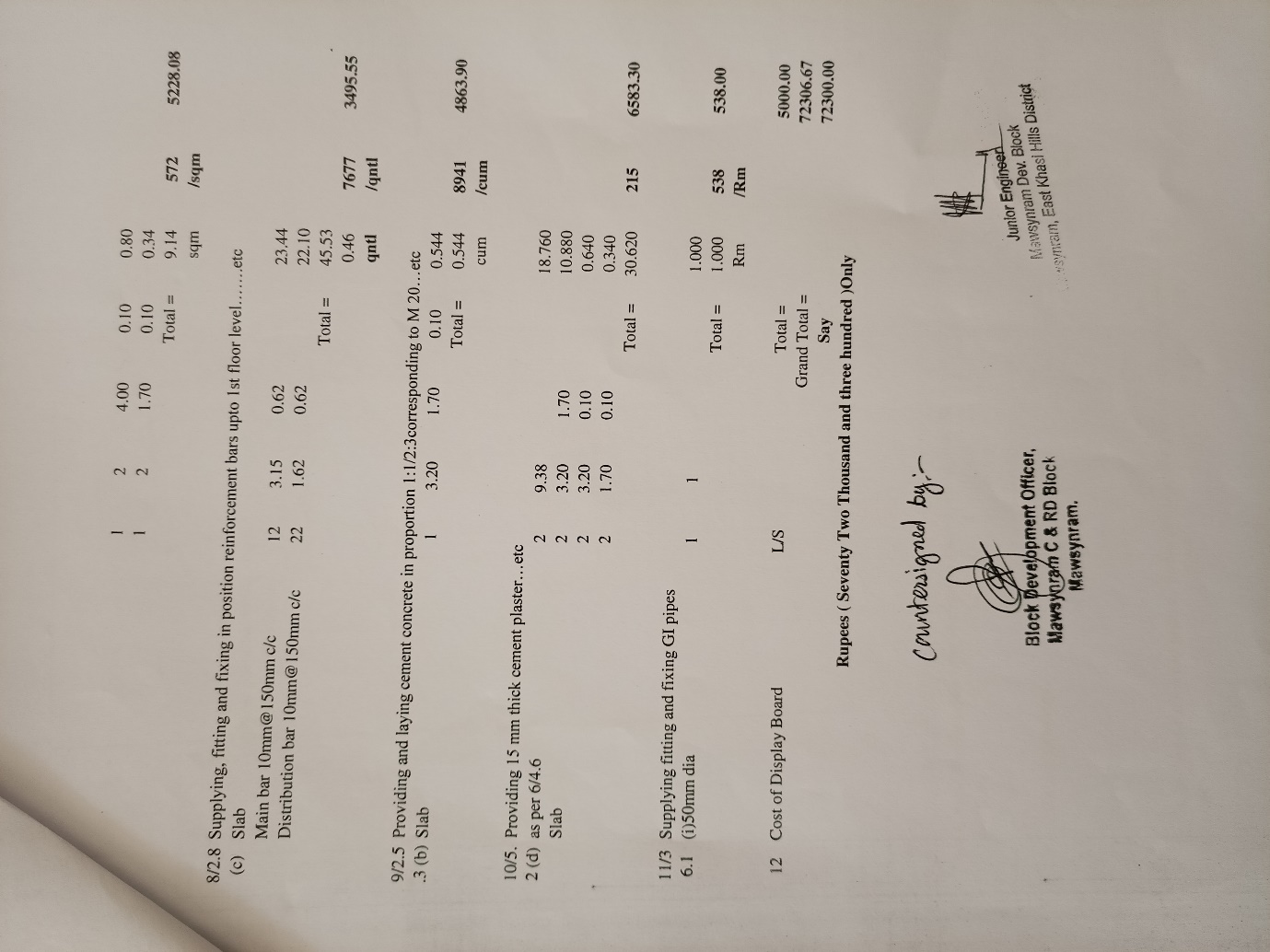
 Budget
Estimates:
Budget
Estimates:
If the answer to the questions posed in the screening process below is ‘Yes’, mitigation measures would be required to be put in place.↩︎
Natural resource (particularly land) ownership and management in Meghalaya is complex – in the presence of customary norms and formal laws. The project intervention will be particularly mindful of such land ownership issues, particularly the nuances of community and private ownership issues. Screening of land sites identified for project interventions: All land for planned interventions would be undertaken on: Existing land available with the implementing agency; Government land accessed through department transfer; Land taken on lease under relevant legal provisions or through voluntary land donation by beneficiaries or taken through lease deed, private market; Purchase agreement or MOU with relevant institutions (like ADCs, Syiems/Nokmas) for community demand driven interventions. No private land acquisition will be undertaken under any project component.↩︎
Voluntary donation of land would be undertaken as per the following principles: That all donors would compulsorily become beneficiaries i.e. no individual or individuals would end up landless and therefore unable to benefit from the demand driven scheme. Such donors are adequately compensated for land given either in cash (at market rates) by purchasing body or given alternate land by contribution from other members. The process of taking such land would involve: Identification of demand from the community followed by assessment of suitability of land as per design; Drawing up of a MOU or agreement with the concerned parties; Such land taken on voluntary donation basis would be duly registered to avoid future complications↩︎
It is to be noted that poverty is not the only indicator that excludes or deprives a person or group from equal access to resources, services and information. Various other indicators such as ethnicity, clan, gender, religion, place of residence, age and others play a very important role in disabling or excluding people from a range of processes and opportunities. CLLMP aims to strengthen the capacities and knowledge of men, women and youths residing in rural Meghalaya. It also aims to ensure that all groups of people in the community are actively involved in the planning, management and monitoring of various initiatives↩︎
The team needs to be cognisant of the possibilities that influx of workers could lead to adverse social and environmental impacts on local communities, especially if the communities are rural, remote or small. Such adverse impacts may include increased demand for goods and services that can lead to price hikes and crowding out of local consumers, increased volume of traffic and higher risk of accidents, increased demands on the ecosystem and natural resources, social conflicts within and between communities, increased risk of spread of communicable diseases, and increased rates of illicit behaviour and crime↩︎
Wherever labour camps will be set up, it will be ensured that the contract labourers are properlydocumented for, the camps have suitable living conditions with safe drinking water, sanitary toilet facilities (earmarked separately for men and women)etc. Contractors’ agreements will have specific clause to ensure child labour and forced labour and banned at project sites, wages are provided as per legal guidelines, labour camp conditions meet adequate quality norms and every contractual employee have proper work-related documentation. The contract should also include clauses regarding reduction of waste general and safe disposal of waste at camp sites; ensure that workers’ camps and associated facilities are connected to septic tank or other wastewater systems which are appropriate and of sufficient capacity for the number of workers and local conditions; avoid contamination of freshwater resources; place workers’ camps away from environmentally sensitive areas to avoid impacts on the local wildlife; route new access routes for workers’ camps to avoid/minimize environmentally sensitive areas; avoid deforestation around camps; provide adequate training to workers on health and safety standards and ensure that children and minors are not employed directly or indirectly on the project↩︎